
In addition, we also offer pre-calibration models. Pre-calibrations are robust, ready-to-use operating procedures for certain applications based on real product spectra. They allow you to immediately start your NIR analysis without any time-consuming sample sourcing, sample preparation, or prediction model development needed. Pre-calibrations are available for quality control of isocyanates, polymers, polyols, fuels, wood pulps, palm oil, food and feed samples, cannabis testing, and more.

Quang phổ cận hồng ngoại
Máy quang phổ cận hồng ngoại là kỹ thuật bổ sung để phân tích nhiều loại mẫu trong phòng thí nghiệm và quy trình, từ chất lỏng, chất rắn và từ bột nhão đến dạng bùn, viên nén và viên nang.
Quang phổ cận hồng ngoại
vi
Máy quang phổ cận hồng ngoại là kỹ thuật bổ sung để phân tích nhiều loại mẫu trong phòng thí nghiệm và quy trình, từ chất lỏng, chất rắn và từ bột nhão đến dạng bùn, viên nén và viên nang.
Bất kỳ yêu cầu của bạn là gì - Chúng tôi đều có hệ thống Quang phổ cận hồng ngoại phù hợp với bạn
Danh mục máy quang phổ cận hồng ngoại của chúng tôi bao gồm các giải pháp trong phòng thí nghiệm và các ngành công nghiệp khác nhau. Sử dụng các bộ lọc để tối ưu hóa tìm kiếm của bạn và tìm hệ thống quang phổ cận hồng ngoại hoàn hảo cho bạn.
Tại sao nên sử dụng máy quang phổ NIR Metrohm? – Chất lượng bạn có thể tin cậy

Kể từ khi thành lập vào năm 1943, Metrohm đã phát triển thành nhà cung cấp đáng tin cậy các thiết bị chất lượng cao và mạnh mẽ nhất quán để phân tích hóa học chính xác và đáng tin cậy.
- Nhận mọi thứ bạn cần cho phép đo quang phổ NIR từ một nhà cung cấp, từ thiết bị NIR đến phần mềm hiệu chuẩn trước và quang phổ NIR.
- Dựa vào kiến thức chuyên môn được biên soạn trong hơn 130 ghi chú ứng dụng.
- Từ sự hiện diện toàn cầu của chúng tôi tại hơn 80 quốc gia sẽ hỗ trợ bạn theo từng quốc gia bởi các chuyên gia về dịch vụ và ứng dụng của chúng tôi.
Khám phá thêm về quang phổ NIR trong các ghi chú ứng dụng và hội thảo trực tuyến do các chuyên gia của chúng tôi cung cấp:
Máy quang phổ hồng ngoại gần – Câu hỏi thường gặp
A near-infrared (NIR) spectrometer measures the interaction of light and matter (i.e., the sample) in the near-infrared region of the electromagnetic spectrum, i.e., in the wavelength range of 780 to 2500 nm.
The molecules in a sample absorb and reflect light differently, based on their chemical and physical structure. By measuring the intensity of light at different wavelengths, a NIR spectroscopy device can generate a spectral profile or fingerprint of a sample.
This profile can then be compared to reference spectra or analyzed using chemometric techniques to identify and quantify the components present in the sample. For instance, the spectral data can be used to quantify key quality parameters such as hydroxyl value, moisture, melt flow index, density, TAN, TBN, viscosity, protein and fat content, and fatty acid distribution. The data can also be used to identify or verify the identity of a sample.
Blog: Benefits of NIR spectroscopy

NIR spectroscopy is a secondary technique. Before starting any routine analysis, a prediction model is required. Prediction models are created using values from primary techniques or reference methods, such as titration.
- Use a primary technique to gather information about the sample, e.g., concentration or other parameters.
- With the NIR instrument, collect NIR spectra from samples with known concentrations or known parameter values. This set of spectra, known as a calibration set, is the basis to create prediction models. Part of the set of spectra is used as validation set to validate the prediction model. Prediction models can be created and validated using spectroscopy software, such as OMNIS Software.
- Once the prediction model has been created and validated, routine analysis can be started at the push of a button.
Metrohm can assist you with creating and validating prediciton models (step 1 and 2), making NIR spectroscopy even simpler and faster for you. Contact us to learn more.

Near-infrared spectroscopy is an analytical technique with numerous applications in various fields. Metrohm NIR analyzers can be used in the following industries:
- chemical
- polyol
- polymer
- food
- animal feed
- pharma
- personal care
- pulp and paper
- paint
- petrochemical
- petrofuel
The NIR instruments can be implemented in the laboratory as well as in the factory for at-line measurements. They are used for quality control and quality assurance, raw material identification, process and reaction monitoring, and screening, providing rapid and non-destructive analysis of samples.

NIR spectrometers analyze multiple parameters within one minute, without needing sample preparation or consumables. Modern NIR spectrometers, such as the OMNIS NIR Analyzer, include additional features that increase productivity:
- Flexibility: measure solid and liquid samples in highest accuracy
- Ease-of-use: create prediction models automatically by using the OMD (OMNIS Model Developer)
- Designed as a platform: fully automate your NIR measurements or combine it with titration
- Compliance: full compliance with FDA 21 CFR Part 11, USP<856> , EP, and JP regulations
- Adaptability: use the instrument as a standalone, or in a client/server environment
The advantages of NIR spectroscopy (NIRS) over IR spectroscopy are:
- The intensity of the bands are lower with NIRS. Thus, there is less detector saturation. This means that for solids you can use pure samples and for liquids the standard method is to use 8 mm vials.
- The energy of the light is higher with NIRS. This leads to deeper sample penetration. This means you can obtain information about the bulk of the sample and not just the surface.
- NIRS can be used for quantification and identification, wheras IR is almost exclusively used for identification.
- NIRS works with fiber optics, which means it can also be used directly in the process.
Learn more about the differences between NIRS and IR in our blog:

The OMNIS NIR Analyzer Liquid/Solid allows for both measurements of solid samples in reflection and measurements of liquid samples in transmission. The instrument can switch conveniently between both measurement modes and no changes in hardware are required. This means that users have a high degree of flexibility and they save time and costs.
The OMNIS platform makes automated and completely unattended NIR measurements possible with the OMNIS NIR Analyzer. There are two options, depending on the application and user preferences.
- The first option is automated measurements of up to more than 200 samples with closed vials for liquid or solid samples using the OMNIS Sample Robot NIR.
- The alternative for liquid samples is a flow-through cell set-up with an OMNIS Sample Robot, also allowing more than 200 samples to be processed and analyzed in series in an unattended manner.
Both options lead to NIR Analyzer setups with full walkaway capabilities.

The Metrohm OMNIS NIR Analyzer series are instruments for the measurement of solid and liquid samples in the area of food & feed as well as chemical, pharma, polymer, and personal care. For food & feed, the OMNIS NIR Analyzer is very suitable to measure moisture, protein, ash, fiber and fats. For edible oil, it can also determine the fatty acid spectrum, i.e. the distribution of the different saturated and unsaturated fatty acids, such as oleic (C18:1) and linoleoic (C18:2) acid.
A large selection of NIR pre-calibrations are availabe with the OMNIS NIR Analyzer. These pre-calibrations are based on numerous real product spectra which means you do not need to perform any sample analysis or model creation. You can use the Metrohm pre-calibrations directly and start using your OMNIS NIR Analyzer immediately. Just unpack and you are ready to be successful.
Metrohm NIR pre-calibrations are available for different products and applications in the areas of polymer, chemicals and food & feed. Examples include:
- PE
- PP
- PET
- PA6
- polyols
- isocyanaytes
- cannabis
- edible oil
- palm-oil
- coffee
- flour
- milk powder
The OMNIS Software includes algorithms such as PCA, PLS, and SVM, enabling users to develop models with high accuracy and robustness. Visualization of sample properties in score, loading, and influence plots simplifies method development and allows users to extract the maximum value from their data, all while maintaining an intuitive workflow.
Furthermore, the OMNIS Software allows the combination of multiple model types to further increase accuracy and expand application possibilities. For example, identification models can be structured into multiple sub-identification models to distinguish even more similar substances, while sub-quantification models can be built for specific concentration ranges to improve accuracy.
Creation of prediction models can be a challenging task for two reasons.
- It requires samples with known reference values for the training set, to serve as a basis for the model development. These samples should cover the expected range for the parameter of interest.
- In order to create a prediction model from these samples, a technique called chemometrics, or multivariate data analysis, needs to be applied. This usually requires that the user has knowledge of chemometrics.
With the OMNIS NIR Analyzer series, everybody can develop prediction models with the OMD (OMNIS Model Developer) and no knowledge of chemometrics is required. The OMD is started with one click in the software and it creates prediction models automatically and without any further user interaction. These models can be saved and immediately used for routine measurements. When more samples have been measured, these models can also be easily updated at a later stage.
Máy quang phổ cận hồng ngoại được vận hành như thế nào?
Máy quang phổ cận hồng ngoại (NIR) đo sự tương tác giữa ánh sáng và vật chất (tức là mẫu) trong vùng cận hồng ngoại của quang phổ điện từ, tức là trong phạm vi bước sóng từ 780 đến 2500 nm.
Các phân tử trong mẫu hấp thụ và phản xạ ánh sáng khác nhau, dựa trên cấu trúc hóa học và vật lý của chúng. Bằng cách đo cường độ ánh sáng ở các bước sóng khác nhau, thiết bị quang phổ NIR có thể tạo ra hồ sơ quang phổ hoặc dấu vân tay của mẫu.
Hồ sơ này sau đó có thể được so sánh với quang phổ tham chiếu hoặc được phân tích bằng các kỹ thuật hóa học để xác định và định lượng các thành phần có trong mẫu. Ví dụ, dữ liệu quang phổ có thể được sử dụng để định lượng các thông số chất lượng chính như giá trị hydroxyl, độ ẩm, chỉ số dòng chảy nóng chảy, mật độ, TAN, TBN và độ nhớt. Dữ liệu cũng có thể được sử dụng để xác định hoặc xác minh danh tính của mẫu.
Blog: Benefits of NIR spectroscopy
Thực hiện phân tích NIR như thế nào?

Phổ NIR là một kỹ thuật thứ cấp. Trước khi bắt đầu bất kỳ phân tích thường quy nào, cần có một mô hình dự đoán. Các mô hình dự đoán được tạo bằng các giá trị từ các kỹ thuật chính hoặc phương pháp tham chiếu, chẳng hạn như chuẩn độ.
- Sử dụng một kỹ thuật chính để thu thập thông tin về mẫu, ví dụ như nồng độ hoặc các thông số khác.
- Với thiết bị NIR, hãy thu thập phổ NIR từ các mẫu có nồng độ hoặc giá trị thông số đã biết. Bộ phổ này, được gọi là bộ hiệu chuẩn, là cơ sở để tạo các mô hình dự đoán. Một phần của bộ phổ được sử dụng làm bộ xác thực để xác thực mô hình dự đoán. Các mô hình dự đoán có thể được tạo và xác thực bằng phần mềm quang phổ, chẳng hạn như Metrohm Vision Air Complete.
- Sau khi mô hình dự đoán đã được tạo và xác thực, có thể bắt đầu phân tích thường quy chỉ bằng một nút nhấn.
Metrohm có thể hỗ trợ bạn tạo và xác thực các mô hình dự đoán (bước 1 và 2), giúp quang phổ NIR trở nên đơn giản và nhanh hơn đối với bạn. Liên hệ với chúng tôi để tìm hiểu thêm.
Ngoài ra, chúng tôi cũng cung cấp các mô hình đường chuẩn dựng sẵn. Dựng đường chuẩn sẵn là các quy trình vận hành mạnh mẽ, sẵn sàng sử dụng cho một số ứng dụng nhất định dựa trên phổ sản phẩm thực tế. Chúng cho phép bạn bắt đầu phân tích NIR ngay lập tức mà không cần mất thời gian tìm nguồn mẫu, chuẩn bị mẫu hoặc phát triển mô hình dự đoán. Hiệu chuẩn trước có sẵn để thử nghiệm cần sa, kiểm soát chất lượng isocyanat, polyme, polyol, nhiên liệu, bột gỗ, dầu cọ và phân người.
Bạn có thể thực hiện những ứng dụng nào với máy quang phổ NIR Metrohm?

Phổ cận hồng ngoại là một kỹ thuật phân tích có nhiều ứng dụng trong nhiều lĩnh vực khác nhau. Máy phân tích NIR Metrohm có thể được sử dụng trong ngành hóa chất, polyol, polyme, thực phẩm, thức ăn chăn nuôi, dược phẩm, bột giấy và giấy, sơn, hóa dầu và nhiên liệu dầu mỏ. Các thiết bị NIR có thể được triển khai trong phòng thí nghiệm cũng như trong nhà máy để đo lường tại chỗ. Chúng được sử dụng để kiểm soát chất lượng và đảm bảo chất lượng, xác định nguyên liệu thô, giám sát quy trình và phản ứng, và sàng lọc, cung cấp phân tích mẫu nhanh chóng và không phá hủy.
NIR spectroscopy: The efficiency boost for QC labs
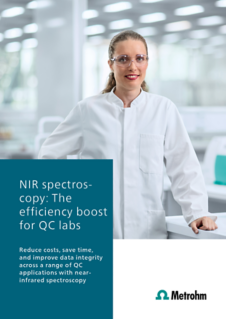
This e-book provides a comprehensive introduction to the topic of fast quality control using near-infrared spectroscopy (NIRS). The e-book presents basic information about the technology and its implementation as well as concrete application examples from various industries (chemical, pharmaceutical, polymer, petro).