



Du har blitt omdirigert til din lokale versjon av den forespurte siden
Oksidasjon og termisk stabilitetsmåling med Rancimat-metoden

Oksidasjon og termisk stabilitetsmåling med Rancimat-metoden

Akselerert aldringstesting (oksidasjonsstabilitetsindeks og stabilitetstid) for naturlige oljer og fett, fettholdige folder og kosmetikk, biodiesel og klorholdige polymerer, som PVC.

Oksidasjon og termisk stabilitetsmåling med Rancimat-metoden

nb

Akselerert aldringstesting (oksidasjonsstabilitetsindeks og stabilitetstid) for naturlige oljer og fett, fettholdige folder og kosmetikk, biodiesel og klorholdige polymerer, som PVC.

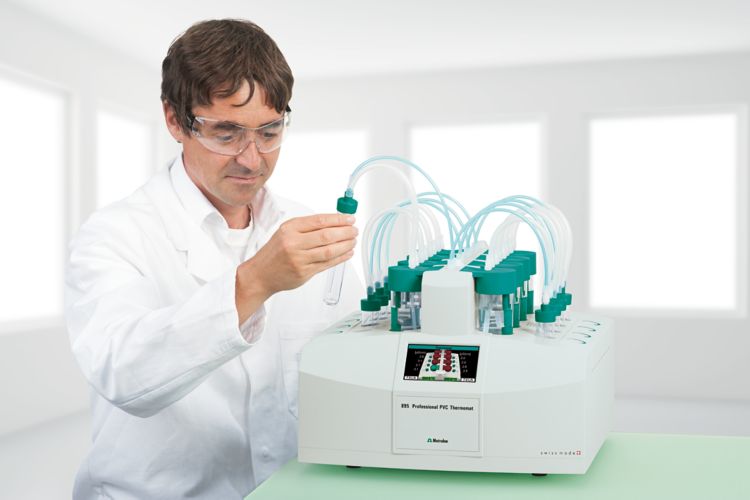
Vi tilbyr tre dedikerte instrumenter for stabilitetsmåling for stabilitetsmåling: Rancimat for vurdering av induksjonstid eller oksidasjonsstabilitetsindeks (OSI) av fettholdige matvarer, kosmetikk og naturlig fett og oljer; de Biodiesel Rancimat for testing av oksidasjonsstabilitet av biodiesel; og PVC-termomat for termisk stabilitetstesting av polyvinylklorid (PVC) og andre klorholdige polymerer ved hjelp av dehydrokloreringstesten (DHC).

  • Dedikerte instrumenter for testing av oksidasjon og termisk stabilitet for naturlige oljer og fett, biodiesel og PVC
  • Overholdelse av internasjonale standarder: AOCS Cd 12b-92, ISO 6886, EN 14112, EN 15751, EN 16568, ISO 182, del 3
  • Praktisk og effektiv: individuell prøveanalyse eller samtidig analyse av 8 prøver
  • Kraftig programvare for instrumentkontroll, datahåndtering og resultatevaluering

Brosjyre: 892 Professional Rancimat (8.892.5001, PDF, 2,1 MB)

Brosjyre: 893 Professional Biodiesel Rancimat (8.893.5001, PDF, 1,5 MB)

Brosjyre: 895 Profesjonell PVC termomat (8.895.5000, PDF, 4 MB)

Ditt valg: individuelle målinger eller bulkanalyse

Stabilitetsinstrumentene har åtte måleposisjoner, slik at du kan starte hver enkelt måling individuelt.

Hvis du derimot må analysere store prøveserier, kan du koble til opptil fire instrumenter og analysere opptil 32 prøver på en gang.

Instrumentkontroll, dataevaluering, administrasjon og lagring: alt i StabNet-programvaren

StabNet er en fullverdig programvare for stabilitetsmåling. Programvaren tar seg av instrumentkontroll og datahåndtering, fra resultatberegning til databasehåndtering og rapportgenerering.

Ved behov kan programvaren settes opp som et klient-server-nettverk, og gir deg tilleggsfunksjoner når det gjelder datatilgang og -administrasjon samt administrasjon av brukerrettigheter.

Which stability solution fits your requirements?

Talk to your Metrohm representative and learn about the best solution for your needs!

Hvitbok: Kvalitetskontroll av fett og oljer i kosmetikk

Download the white paper

Lær hvordan Rancimat-testen kan brukes til å vurdere oksidasjonsstabiliteten til naturlig fett og oljer som en kvalitetsindikator.

Finn applikasjoner for stabilitetsmåling

Stability measurement – FAQs

Our established Rancimat method is based on accelerating the oxidation process of the sample by raising its temperature and passing a continuous stream of air through it. The air flow transports volatile oxidation products from the sample vessel into a vessel containing distilled water. The oxidative stability instrument measures the conductivity of the water. A sudden, strong increase in conductivity marks the induction time.

The induction time is a standard parameter in quality testing of oils and fats in the food industry and gives indications about the remaining shelf life of a product.

The dehydrochlorination test is done by heating the polymer sample to induce decomposition. As a result of the decomposition, gaseous hydrochloride (HCl) is released. The HCl that is released is transported from the sample vessel into a vessel containing distilled water by means of a continuous stream of nitrogen. In the sample vessel, the conductivity is continuously measured. Once HCl is formed, the conductivity increases. The time at which a 50 µS/cm increase is reached compared to the beginning of the measurement is the stability time, a measure of thermostability.

The Rancimat method is widely recognized by international standards for determining the oxidation stability of fats, oils, and biodiesel. It is included in several standards, including:

  • ISO 6886 Animal and vegetable fats and oils – Determination of oxidative stability (accelerated oxidation test)
  • AOCS Cd 12b-92 Oil stability index. Sampling and analysis of commercial fats and oils
  • EN 14112 Fat and oil derivatives – Fatty Acid Methyl Esters (FAME) – Determination of oxidation stability (accelerated oxidation test) (also referenced in DIN EN 14214)
  • ASTM D6751 Standard Specification for Biodiesel Fuel Blend Stock (B100) for Middle Distillate Fuels

Yes, the OSI is a synonym for the induction period, which is the time at a specific temperature and gas flow until the oil turns rancid. This is exactly what the Rancimat determines.

There are different norms available to determine the oxidation stability index. Each norm has slightly different parameters. Find out more about the parameters of the norms in this application note:

Application Note: Oxidation stability comparison of AOCS Cd 12b-92 and EN ISO 6886

The Rancimat method is the most common method to determine the oxidation stability of edible oils. It provides reliable and rapid results suitable for both research and industrial quality control purposes.

Learn more in our blog:

Blog: How to determine if your edible oils are rancid

You can determine the oxidation resistance of biodiesel with the 893 Professional Biodiesel Rancimat.

During measurement, a stream of air is passed through the fatty acid methyl ester sample (Biodiesel) contained in a closed and heated reaction vessel. This treatment results in oxidation of the alkyl ester molecules in the sample, with peroxides initially being formed as the primary oxidation products. After some time, the fatty acid methyl esters begin to decompose, and the secondary oxidation products thus formed include low-molecular organic acids such as acetic acid and formic acid in addition to other volatile organic compounds. These are transported by the airstream to a second vessel containing distilled water, where the conductivity is measured continuously. The organic acids can be detected by the increase in conductivity. The time that elapses until these secondary reaction products appear is called induction time or induction period and characterizes the quality of the sample.

Application Note: Oxidation stability of diesel, biodiesel, and blends

Application Note: Oxidation stability of fatty acid methyl esters (FAME, biodiesel)

The shelf life of materials is influenced by various factors including:

  • temperature
  • oxygen exposure
  • UV light
  • microbial growth

The Rancimat method exclusively measures oxidation stability at elevated temperatures, making it unsuitable for direct shelf-life determination. However, the induction time provides an indication of oil stability when other influencing factors are excluded. Our software allows extrapolation to room temperature using the Arrhenius equation, offering a rough shelf-life estimate.

For accurate shelf-life determination, samples must be stored under defined conditions, and test results should then be correlated with the induction time.

The sample size varies depending on the norm and the sample type.

  • For edible oil samples, the sample size is typically 3 g
  • For solid food samples, e.g., grinded nuts, the sample size is 0.5 g.
  • For Biodiesel samples, the size varies between 3.5 g and 7.5 g.
  • For PVC samples, the sample size is typically 0.5 g.

Find more information about the recommended sample sizes in our application documents:

Applications for stability measurements

Emulsions cannot be measured directly with the Rancimat. However, we developed two methods to make it possible.

The first method is a cold extraction. For this, the fat of the emulsion is extracted with a non-polar solvent like low boiling petrol ether. The solvent which contains the oil is then separated from the matrix and evaporated in a rotavapor. The left-over oil is measured as a normal oil.

As the extraction process includes some labor-intensive steps, we developed an alternative method. In this second method, we measure the antioxidation capacity of the emulsion on a material that normally decomposes very quickly at elevated temperatures. We use PEG3000 as carrier material and we call the method PEG Method.

Find out more about the PEG method