You have been redirected to your local version of the requested page

QC and product screening of ink and paint with NIRS

QC and product screening of ink and paint with NIRS

Nov 27, 2023

Article

We encounter ink and paint on a daily basis. These materials are used for writing and printing, protection against the elements, aesthetic reasons, and so much more. Our historical record exists in large part due to these substances. How are paints and inks manufactured and what quality control (QC) measures are taken? This blog article covers a brief history of this industry, the manufacturing process, and how near-infrared spectroscopy (NIRS) can be used as a multi-parameter QC solution.

What is the difference between paint and ink?

Paint is a substance applied as a liquid or paste that dries into a solid coating. This coating protects and/or adds color to the object or surface to which it has been applied. 

Ink is a pigment- or dye-based fluid used for writing, printing, etc.

Origins and brief historical overview of ink and paint

Click on the arrows below to learn more about the origins and history of these two materials.

What is paint made of?

Paint typically consists of pigment, resin, solvent, and additives.

Pigments are used to provide color and to control the level of gloss. A lower pigment volume concentration (PVC) results in a glossy finish while a high PVC gives a flat matte appearance.

Resin is the binder which holds the pigment particles together and provides adhesion to the surface which is painted.

The solvent acts as a carrier for the pigments and resin. It may be organic or water based.

Additives are used to enhance certain properties such as ease of brushing, mold resistance, scuff resistance, drying, and sag resistance.

How is paint manufactured?

The production process for paint can be divided into four basic steps. First, the paste is made (Figure 1), then the pigments are milled and dispersed for homogeneity purposes (Figure 2). In the third step, the paste is thinned (Figure 3), and finally the end product is packaged (Figure 4). 

However, different ingredients require adaptation of the production process, and the displayed example is a generalization. Coatings are made in a batch process and stringent tests are applied throughout the entire production process to ensure quality.

The first step in paint production is making the paste by mixing pigments, additives, binder, and solvents.
Figure 1. The first step in paint production is making the paste by mixing pigments, additives, binder, and solvents.
The second step in paint production is milling and dispersing pigments in the paste.
Figure 2. The second step in paint production is milling and dispersing pigments in the paste.
The third step in paint production is where the paste is thinned out with solvents, binder, and additional pigments.
Figure 3. The third step in paint production is where the paste is thinned out with solvents, binder, and additional pigments.
The final step in paint production is packaging the final product once it has been filtered.
Figure 4. The final step in paint production is packaging the final product once it has been filtered.

Quality control and screening of ink and paint 

Quality control (QC) of ink and paint can be done easily during all stages of production with near-infrared (NIR) spectroscopy. Using NIRS for QC and screening of ink and paint is more efficient and cost-effective than other analytical methods. 

The rest of this blog article covers a brief overview of NIR spectroscopy and its applications for the ink and paint industry. Examples are provided of how ink and paint producers can benefit from using NIRS instruments for assurance and quality control to make high quality products.

NIR spectroscopy – how does it work?

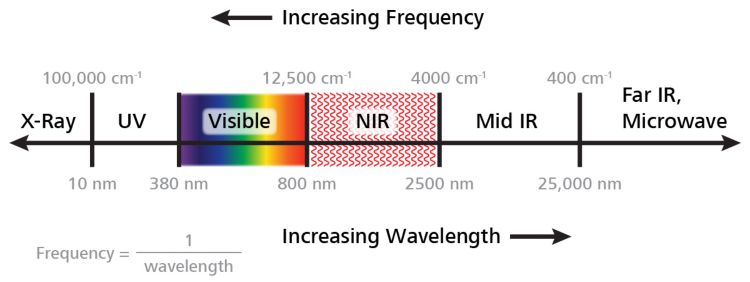
NIR spectroscopy is an analytical technique that uses the interaction between light and matter to determine a sample’s chemical and physical parameters. In this situation, light is described by wavelength or wavenumbers rather than the applied energy. The interaction can be measured, e.g., with the Metrohm DS2500 Liquid Analyzer (Figure 5a), which generates NIR spectra (Figure 5b).

a) The Metrohm NIRS DS2500 Liquid Analyzer. b) Example of spectra resulting from the interaction of NIR light with five different paint drier samples.
Figure 5. a) The Metrohm NIRS DS2500 Liquid Analyzer. b) Example of spectra resulting from the interaction of NIR light with five different paint drier samples.

As NIRS is quite sensitive to the presence of some molecular functional groups, it is an ideal technique to quantify many chemical parameters. Non-volatile contentvolatile organic compounds, dye contentsurfactant content, and moisture can be measured simultaneously in paint or ink. Even the detection of physical parameters such as density and viscosity is possible with NIRS. 

A single NIR spectrum contains all of this information, making near-infrared spectroscopy suitable for quick multi-parameter analysis. 

Choice of NIRS measuring mode

The NIRS measuring mode depends on the type of sample to be analyzed. 

When analyzing liquids, the transmission mode is appropriate (Figure 6). During transmission, the NIR light gets absorbed while traveling through the sample, and unabsorbed light goes directly to the detector. 

a) Measurements of liquids are typically done with disposable vials. b) The NIRS measurement mode is known as transmission, where light travels through the sample while being absorbed (from left to right in the illustration).
Figure 6. a) Measurements of liquids are typically done with disposable vials. b) The NIRS measurement mode is known as transmission, where light travels through the sample while being absorbed (from left to right in the illustration).

When analyzing pastes, the transflection mode is preferred (Figure 7). Here, a gold stamp is used as a diffuse reflector. In this case, the NIR light is directed through the paste sample while being absorbed and is reflected by the gold stamp. The reflected NIR light is absorbed further by the sample and finally reaches the detector.

a) The measurement of pastes is typically done in a slurry cup by using a gold stamp as the diffuse reflector. b) The measurement mode is known as transflection, where light travels through the sample, reflects on the diffuse reflector, and travels again through the sample while being absorbed.
Figure 7. a) The measurement of pastes is typically done in a slurry cup by using a gold stamp as the diffuse reflector. b) The measurement mode is known as transflection, where light travels through the sample, reflects on the diffuse reflector, and travels again through the sample while being absorbed.

Advantages of using NIRS for QC and screening purposes

Near-infrared spectroscopy has several advantages over other analytical techniques, especially when it comes to quality control and screening. 

NIRS is fast, providing results in less than one minute. No sample preparation is required, saving even more time. Measurements are non-destructive, so samples can be reused. No reagents are needed when using NIR spectroscopy for analysis. Not only does this lower the cost per sample, it also makes this technique environmentally friendly. 

NIRS is also compliant with international standards such as ASTM E1655: Standard Practices for Infrared Multivariate Quantitative Analysis, making it simpler for industries to adopt it. Finally, NIRS is easy to use and can be operated by non-technical personnel, unlike other more complicated analytical techniques.

Quality control and screening parameters for ink and paint production

Ink and paint products are subjected to several standardized test methods to determine their chemical and physical properties. Such laboratory testing is an indispensable part of research and development and quality control. Table 1 lists the most relevant test parameters for the quality control and screening of ink and paint.

Application examples showing the capability of NIRS to analyze several of these parameters simultaneously from the same sample follow in the next sections.

Table 1. Various QC and screening parameters for ink and paint along with the typical method used for analysis.

Parameter Conventional analysis method
Intrinsic, kinematic viscosity Viscometry
Moisture Karl Fischer titration
Surfactant content Titration
Non-volatile content / Solids content Loss on drying (LOD)
Dye content / Pigment content Ashing
Volatile organic compounds (VOC) Multiple wet chemical methods
Additives and wax in packaging paint HPLC and GC

Application example: Quality control of ink with NIRS

When performing quality control checks during ink production, the typical parameters measured are the content of dye, diethylene glycol (DEG), surfactant, and water. The dye (e.g., triphenylmethane/phenazine or azo dyes) gives the ink its color. Diethylene glycol is used as a solvent and prevents the ink from drying out. Surfactants control the texture and prevent the ink from foaming.

These parameters are usually monitored using different analytical techniques including ashing, titration, and Karl Fischer titration. Sample preparation is time consuming, and the use of multiple determination methods is cumbersome. By using NIRS, several QC parameters for ink can be measured simultaneously, with results given in less than one minute. 

NIR spectra from several ink samples are shown in Figure 8 with the respective correlation diagram for the prediction of dye content in Figure 9. The figures of merit for the NIRS prediction of dye, DEG, surfactant, and water in ink are given in Table 2.

Selection of Vis-NIR spectra from ink samples measured on a Metrohm NIRS DS2500 Analyzer in transflection mode. The inlay shows how the spectra differ with varying dye content.
Figure 8. Selection of Vis-NIR spectra from ink samples measured on a Metrohm NIRS DS2500 Analyzer in transflection mode. The inlay shows how the spectra differ with varying dye content.
Correlation diagram for the prediction of dye content in ink using a Metrohm NIRS DS2500 Analyzer.
Figure 9. Correlation diagram for the prediction of dye content in ink using a Metrohm NIRS DS2500 Analyzer.

Table 2. Figures of merit for various QC parameters in ink samples using a Metrohm NIRS DS2500 Analyzer.

Figures of merit Dye content DEG content Water content Surfactant content
R2 0.996 0.993 0.991 0.977
Standard Error of Calibration (SEC) 0.0835% 0.5037% 0.5571% 0.0368%
Standard Error of Cross Validation (SECV) 0.0949% 0.5888% 0.9614% 0.1316%

Application example: Quality control of paint driers with NIRS

Paint driers decrease the drying time of paints and affect the gloss and clarity of the coating. In this case, the main QC parameters of interest are the metal content, solid content, viscosity, and specific gravity. 

All reference test procedures for these parameters are specified in ASTM procedures—ASTM D2373, ASTM D1644, ASTM D5125, and ASTM D2196. Each standard uses different analytical instruments for measurement: balances and ovens, titrators, hydrometers, and viscometers. In contrast, using NIRS to measure all of these parameters simultaneously saves a significant amount of time and reduces the costs per analysis.

Selection of Vis-NIR spectra from paint drier samples measured on a Metrohm NIRS DS2500 Liquid Analyzer in transmission mode. The spectra differ with varying cobalt content.
Figure 10. Selection of Vis-NIR spectra from paint drier samples measured on a Metrohm NIRS DS2500 Liquid Analyzer in transmission mode. The spectra differ with varying cobalt content.
Correlation diagram for the prediction of cobalt content in paint driers using a Metrohm NIRS DS2500 Liquid Analyzer.
Figure 11. Correlation diagram for the prediction of cobalt content in paint driers using a Metrohm NIRS DS2500 Liquid Analyzer.

Table 3. Figures of merit for various QC parameters in paint drier samples using a Metrohm NIRS DS2500 Liquid Analyzer.

Figures of merit Cobalt content* Solids content Specific gravity Viscosity
R2 0.999 0.999 0.977 0.999
SEC 0.08% 0.24% 0.003% 9.3 MPa
SECV 0.09% 0.29% 0.003% 10.9 MPa
* The spectral range with best results for cobalt measurement was in the visible region (400–800 nm, see Figure 9).

Summary

NIRS is an excellent choice for quality control and screening of ink and paint along the entire production chain, from raw materials to finished products. Its advantages over other analytical techniques cannot be understated. The ability to perform multi-parameter analysis on a single sample with results in less than one minute saves an incredible amount of time and money. 

Conventional laboratory techniques usually require sample preconditioning or chemicals and skilled personnel to perform the analyses. Each parameter is measured on a different instrument, and therefore results take much longer to generate. 

Boost efficiency in the QC laboratory: How NIRS helps reduce costs up to 90%

Click here to download

Underestimating QC processes is one of the major factors leading to internal and external product failure, which have been reported to cause a loss of turnover between 10–30%. As a result, many different norms are put in place to support manufacturers with this. However, time to result and the associated costs for chemicals can be quite excessive, leading many companies to implement near-infrared spectroscopy in their QC process. This White Paper illustrates the potential of NIRS and displays cost saving potentials up to 90%.

Authors
Guns

Wim Guns

International Sales Support Spectroscopy
Metrohm International Headquarters, Herisau, Switzerland

Contact

Lanciki

Dr. Alyson Lanciki

Scientific Editor
Metrohm International Headquarters, Herisau, Switzerland

Contact