Thermometric titration – the missing piece of the puzzle
26 mai 2026
Articol
 Distribuiți articolul
Titration is taught to every chemistry student. Nearly every analytical laboratory runs either manual titrations, photometric titrations, or potentiometric titrations. In this blog post, we present an additional kind of titration you may not have heard of before – thermometric titration. It can be considered the missing piece of the titration puzzle.
This article covers the following topics:
What is thermometric titration?

Thermometric titration, or TET, is based on the principle of enthalpy change (ΔH). Each chemical reaction has a change in enthalpy, which in turn causes a temperature change. During a titration, the analyte and titrant react either exothermically (increase in temperature) or endothermically (decrease in temperature).
In the case of thermometric titration, an automatic buret adds the titrant at a constant rate. The change in temperature caused by the reaction between analyte and titrant is measured. A break within the titration curve (temperature versus the added titrant volume) indicates the endpoint. Figure 1 shows idealized thermometric titration curves for both exothermic and endothermic reactions.
What happens during a thermometric titration?

During an exothermic titration reaction, the temperature increases with the titrant addition if analyte is still present. Once all analyte is consumed, the temperature decreases again as the solution equilibrates with the ambient temperature and/or due to the dilution of the solution with titrant (Figure 1, left graph). This temperature decrease results in an exothermic endpoint.
On the contrary, for an endothermic titration reaction, the temperature decreases with the titrant addition if analyte is still available. When all analyte is consumed, the temperature stabilizes or increases again as the solution equilibrates with the ambient temperature and/or due to the dilution of the solution with titrant (Figure 1, right graph). This temperature increase results in an endothermic endpoint.
It is not necessary to know the absolute temperature, insulate the titration vessel, nor thermostat the titration vessel, because only the used volume of the titrant is important for the calculation of the sample content.
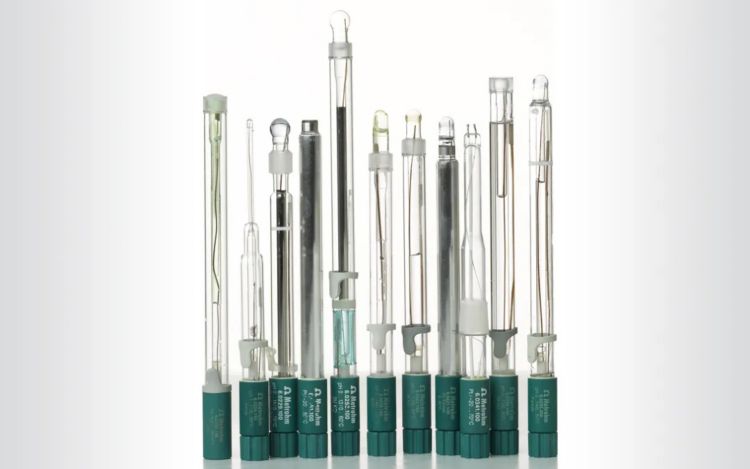
A very fast-responding thermistor with a high resolution is required to measure the small temperature changes during the titration. These sensors (Figure 2) are capable of measuring temperature differences of 0.0001 °C and can collect a measuring point every 100 ms.
Why consider thermometric titration?
Potentiometric and photometric titration are already well established as instrumental titration techniques, so why should one consider thermometric titration instead?
TET has the advantages of any instrumental titration techniques:
- Inexpensive analyses: Titrators are inexpensive to purchase and do not have high running and maintenance costs compared to other instruments for elemental analysis (e.g., HPLC or ICP-MS).
- Absolute method: Titration is an absolute method, meaning it is not necessary to frequently calibrate the system.
- Versatile use: Titration is a universal method which is used to determine many different analytes in various industries.
- Easy to automate: Titration can be easily automated, increasing reproducibility and efficiency in your lab. Read more about this in our blog «Why consider automation – even for simple titrations».
Compared to classical instrumental titration, thermometric titration offers several further advantages:
- Fast titrations: Thermometric titrations are very fast. Typically, a thermometric titration takes two to three minutes.
- Single sensor: The same sensor (dThermoprobe) can be used regardless of the titration reaction (e.g., acid-base, redox, precipitation, etc.).
- Maintenance-free sensor: The dThermoprobe is maintenance free. It requires no calibration nor electrolyte filling and can simply be stored dry.
- Less solvent: Typically, thermometric titrations use 30 mL of solvent. The small solvent volume ensures that dilution is minimized and the enthalpy changes can be detected reliably. As a side benefit, less waste is produced.
- Additional titrations possible: Because enthalpy change is universal for any chemical reaction, thermometric titration is not limited by color indicators or indication electrodes. This allows for the possibility of additional titrations which cannot be covered by other kinds of titration.
- Easier sample preparation: As TET uses higher titrant concentrations, it is possible to use larger sample sizes, reducing weighing and dilution errors. Tedious sample preparation steps such as filtration can be omitted as well.
Find out more about thermometric titration with this free download:
How to carry out a thermometric titration

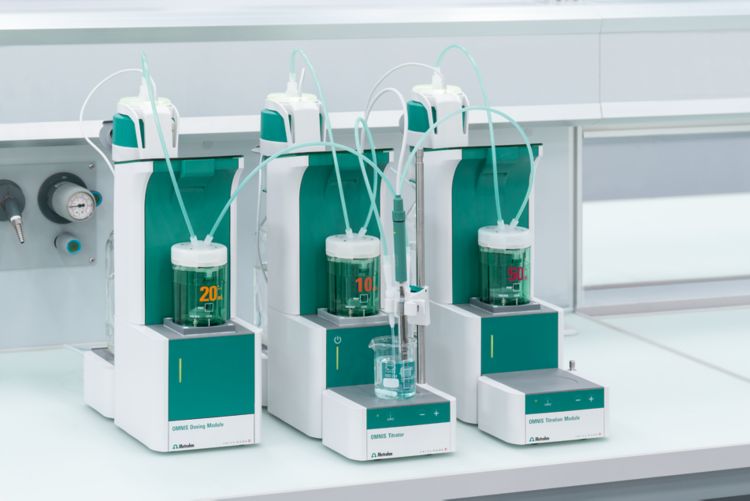
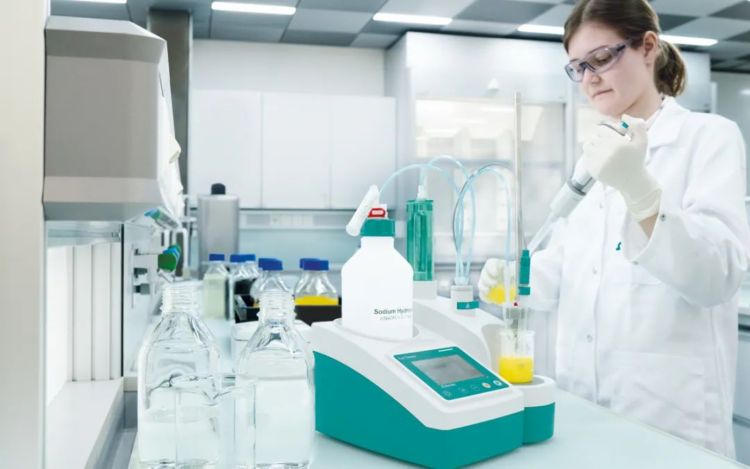
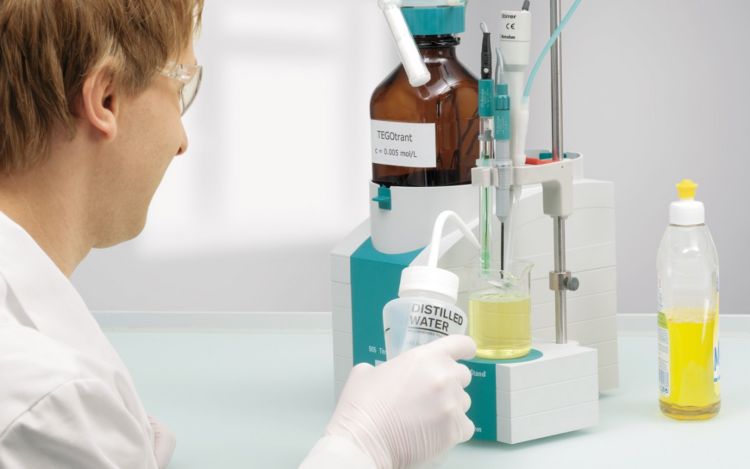
After getting familiarized with the basics of thermometric titration, let's take a closer look at the system setup. Thermometric titration is integrated into the OMNIS platform, so all you need is an OMNIS Titrator (Figure 3) and the dThermoprobe (Figure 2).
As for every titration, the titration cell setup is crucial. We highly recommend using a rod stirrer for TET to ensure strong mixing. Strong stirring usually reduces the signal noise, leading to smoother titration curves. Nevertheless, avoid splashing and creating a strong vortex. Otherwise, the sensor might not be properly immersed in the solution.

The buret tip containing the titrant should be mounted downstream from the sensor in the direction of stirring, as indicated in Figure 4. Doing so results in better titration curves due to reduced signal noise. Moreover, the dThermoprobe and the buret tip should be mounted around 1 mm above the propeller blades. However, neither the tubing nor the sensor should touch the stirrer, as this can cause noisy curves.
During the titration, the titrant is added constantly at a defined dosing rate using an automatic buret. This is why TET is faster than a potentiometric titration, where you add (defined) volume increments and wait for the drift to stabilize.
After the titration is finished, the sensor is simply rinsed with a suitable solvent. Since the thermistor is so sensitive, be careful and do not clean it with a sonicator or even something as simple as a toothbrush.
Titer and blank determination
Titer

Like any other titration, you should perform a titer determination before measuring the sample. Titer determination in thermometric titration differs from potentiometric titration. In TET, the titer is determined via linear regression, which the OMNIS software performs automatically.
To obtain the linear regression, the sample size (x-axis) is plotted against the consumption of the titrant (y-axis). This means you will need to titrate different amounts of a suitable standard to obtain the graph. Figure 5 illustrates this concept.
Blank
The blank determination in TET is different from the usual solvent blank determination in titration. Just as for the titer determination, a linear regression is calculated here. Different sample sizes are titrated and plotted against the titrant consumption.
The same formula y = ax + b is used. For the blank determination, the y-intercept (b) is used instead of the slope (a). The y-intercept (b) directly corresponds to the blank value.
A significant advantage of the linear regression is that you can (and should) use the coefficient of determination (R2) to validate the linearity of the titration. We recommend a value greater than 0.999.
The advantage of this type of blank determination is that the whole system is considered. Table 1 compares the blank determination in thermometric and potentiometric titration.
| Thermometry – Method Blank | Potentiometry – Solvent Blank | |
|---|---|---|
| Determination style | Determined with sample | Determined without sample |
| Calculation method | Linear regression | Direct calculation |
| Blank value | Can be negative | Cannot be negative |
| Titration parameters | Same parameters for blank and sample determination | Different parameters for blank and sample determination |
Thermometric titration examples
In this section we present some practical applications of thermometric titration.
Acid number and base number

The acid number (AN) and base number (BN) are two key quality parameters used in the petroleum industry. They are determined by a nonaqueous acid-base titration using KOH or HClO4, respectively, as titrant.
During such determinations, very weak acids (for AN analysis) and bases (for BN analysis) are titrated with only small enthalpy changes. Using a catalytic indicator, these weak acids and bases can also be determined by TET.
ASTM D8045 describes the analysis of the AN by thermometric titration for crude oil.
If you wish to learn more about this TET application, read our blog post «Fast determination of acid and base number by thermometric titration».
Sodium
Using conventional titration, the salt content in foodstuff is usually determined based solely on the chloride content. However, foods usually contain additional sources of sodium, e.g., monosodium glutamate (also known as MSG). With TET, it becomes possible to titrate the sodium directly and thus to inexpensively determine the true sodium content in foodstuff.
Watch the video to learn more about sodium determination with TET.
For more detailed information on the titration itself, download this free Application Bulletin:
AB-298: Sodium determination in various foods with thermometric titration
Fertilizer analysis

Fertilizers consist of various nutrients, including phosphorus, nitrogen, and potassium, which are important for plant growth. TET enables the analysis of these nutrients by employing classical gravimetric reactions as the basis for the titration (e.g., precipitation of sulfate with barium). This allows for a rapid determination without needing to wait hours for a result as with conventional procedures based on drying and weighing the precipitate.
Want to learn more about the analysis of fertilizers with thermometric titration? Read our blog article «Multiparameter analysis in fertilizers by thermometric titration».
Metal-organic compounds
Metal-organic compounds, such as Grignard reagents or butyl lithium compounds, are used for synthetizing active pharmaceutical ingredients (APIs) or manufacturing polymers such as polybutadiene. With TET, the analysis of these sensitive species can be performed rapidly and reliably by titrating them under inert gas with 2-butanol.
Download the Application Note below for more information about this topic.
Summary
These were just a few examples about the possibilities of thermometric titration to demonstrate its versatile use. For more examples of TET in action, have a look at our Application Finder.
Thermometric titration
Key learnings
- TET is an alternative titration method based on enthalpy change
- Thermometric titration is a fast analysis technique providing results in less than three minutes
- The robust and sensitive dThermoprobe is used to determine exothermic and endothermic endpoints
- Thermometric titration can be used for various analyses, including titrations which cannot be performed otherwise (e.g., sodium determination)
Additional resources
Brochure: Thermometric Titration with OMNIS