Sie wurden zu Ihrer lokalen Version der angefragten Seite umgeleitet
Elektrochemilumineszenz: Die nächste Stufe in optischer Empfindlichkeit

Elektrochemilumineszenz: Die nächste Stufe in optischer Empfindlichkeit

Vielseitigkeit, Einfachheit und verbesserte Synchronisation und Empfindlichkeit für die ECL-Analysetechnik.

Elektrochemilumineszenz: Die nächste Stufe in optischer Empfindlichkeit

de

Vielseitigkeit, Einfachheit und verbesserte Synchronisation und Empfindlichkeit für die ECL-Analysetechnik.

Elektrochemilumineszenz (ECL) ist die Kombination aus Elektrochemie und Chemilumineszenz. Elektrogenerierte Chemilumineszenzsignale werden in der Regel aus den angeregten Zuständen eines Luminophors gewonnen, die während der elektrochemischen Reaktion an der Elektrodenoberfläche entstehen. Die elektrogenerierte Chemilumineszenz wird für verschiedene Applikationen genutzt, unter anderem für die Lebensmittel- und klinische Analyse.

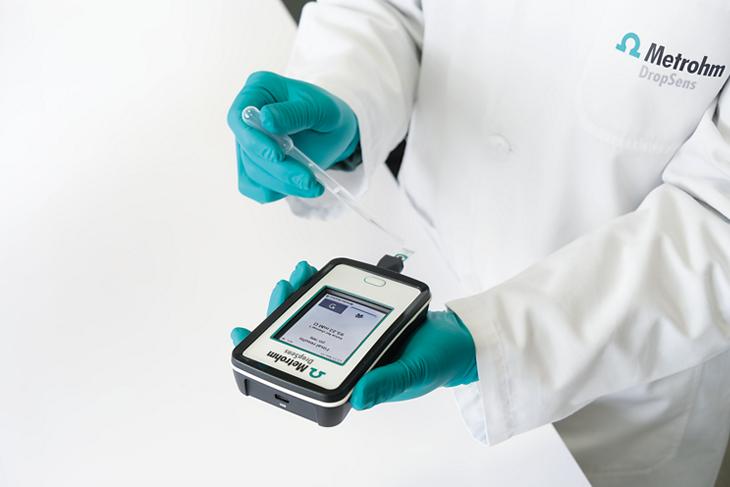
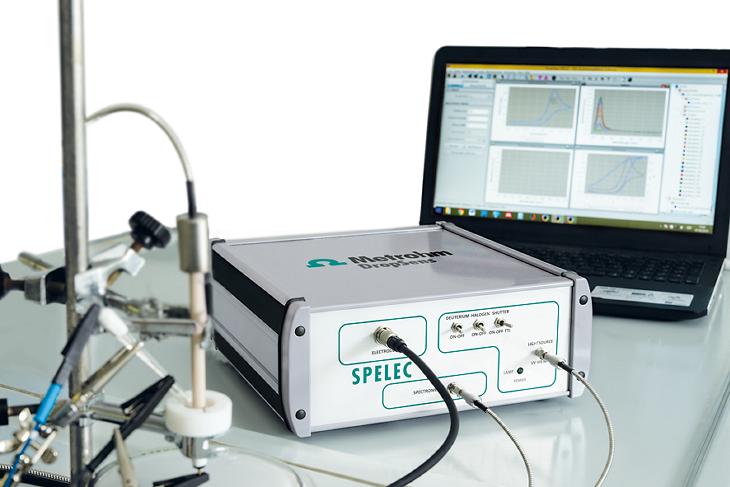
Metrohm DropSens bietet miniaturisierte und tragbare Elektrochemilumineszenzgeräte an, die aus einem Bipotentiostat/Galvanostat in Kombination mit einer ECL-Zelle bestehen:

  • Kompakte und vielseitige Lösungen
  • Tragbare Systeme mit vereinfachtem optischem Aufbau
  • Erhöhte Testempflindlichkeit
  • Sofortige Datensynchronisation
  • Beinhaltet spezifische, hochentwickelte Messzellen für das Messen mit siebgedruckten Elektroden
  • Software mit dedizierten Funktionen für ECL Untersuchungen

Robust, tragbar und vielseitig

Elektrochemilumineszenz-Systeme bestehen aus einem Bipotentiostat/Galvanostat, der es durch Anlegen von Spannungs- oder Strompulsen ermöglicht, Reaktionen in einem Luminophor auszulösen. Der Anregungszustand des Luminophors wird über eine Messzelle erfasst, die den Detektor (je nach Modell eine Photodiode oder ein Mikrospektrometer) enthält. Die DropSens-Systeme von Metrohm sind miniaturisiert und tragbar - perfekt für die elektrogenerierte Chemilumineszenz (ECL)-Analyse.

Die Geräte können auch unabhängig voneinander als Bipotentiostat/Galvanostat für elektrochemische Analysen mit allen Eigenschaften der Metrohm DropSens-Geräte eingesetzt werden. Je nach ECL-Gerät können die Zellen auch kombiniert werden.

Sofortige Synchronisation

Die elektrochemischen und chemilumineszenz-Signale werden perfekt synchronisiert und in Echtzeit angezeigt. Darüber hinaus ermöglichen die Metrohm DropSens-Geräte eine gute zeitliche und räumliche Kontrolle dieser Analysetechniken, selbst wenn die Lichtsignale sehr gering sind.

Welcher Potentiostat/Galvanostat passt zu Ihren Anforderungen?

Sprechen Sie mit uns und informieren Sie sich über die beste Lösung für Ihre Anforderungen!

ECL processes involve a luminophore, a co-reactant, and electrochemistry.

  • The luminophore is the key light-emitting molecule responsible of the emission of light during the ECL reaction. It provides the sensitivity, specificity, and efficiency of the ECL system. Its selection is critical to the development of new applications.
  • The co-reactant plays a crucial role in the generation of the excited states of the luminophore. Its primary function is to participate in the electrochemical reaction close to the electrode surface, generating reactive intermediates that interact with the luminophore.
  • Electrochemistry enables the oxidation and/or reduction of the luminophore and co-reactants at the electrode surface. These reactions are essential for the formation of the reactive species required for ECL.

ECL typically follows these steps:

  1. Electrochemical application of a potential/current to the working electrode.
  2. Generation of reactive intermediates via redox reactions of the luminophore or the co-reactant.
  3. Formation of an excited state close to the electrode surface upon interaction of intermediates.
  4. Emission of light when the excited state returns to the ground state.

Electrochemiluminescence offers the following advantages:

  • High sensitivity: ECL allows the detection of very low concentrations of analytes, making it ideal for applications such as medical diagnostics and environmental monitoring.
  • Excellent specificity: Combined with specific recognition elements (e.g., antibodies or DNA probes), ECL ensures high selectivity in detecting target molecules.
  • Wide dynamic range: It can measure analyte concentrations over several orders of magnitude, accommodating both very low and high levels of detection.
  • Minimal background noise: Since the luminescence signal is generated electrochemically, ECL exhibits lower background interference compared to other luminescent methods.
  • Versatility: It is compatible with a wide range of molecules and analytes, from small compounds to large biomolecules like proteins and nucleic acids.
  • Speed and reproducibility: The technique provides rapid results with high reproducibility, essential for high throughput testing.
  • Robustness: The reagents and setups are generally stable, ensuring reliable performance over time.

Its unique properties make electrochemiluminescence highly versatile:

  • Biosensing and medical diagnostics: ECL is widely used in clinical and biomedical research for detecting biomolecules with high sensitivity and specificity.
  • Pharmaceutical and drug development: ECL is utilized in pharmaceutical research for the development of drugs and quality control.
  • Food safety and environmental monitoring: ECL plays a crucial role in the detection of contaminants and monitoring of environmental safety.
  • Material science and nanotechnology: ECL is used in the characterization of novel materials and in the design of advanced sensors.
  • Clinical research: ECL platforms are used in the development of personalized therapeutic strategies. 
  • Analytical chemistry: ECL is a key technique in the detection and quantification of trace levels of analytes.
  • Forensic science: ECL is used to detect traces of substances such as drug residues and explosive materials.

The following luminophores are mostly used:

  • Ruthenium complexes (e.g., Ru(bpy)32+) are widely used in biosensing due to their high stability and strong luminescence.
  • Luminol is often used in forensic science and environmental testing.
  • Quantum dots and nanomaterials offer tunable luminescence and enhanced performance in advanced ECL applications.
Entdecken Sie die Metrohm Potentiostaten/Galvanostaten