You have been redirected to your local version of the requested page
Electrochemiluminescence: the next level in optical sensitivity

Electrochemiluminescence: the next level in optical sensitivity

เครื่องวิเคราะห์ด้วยเทคนิค Electrochemical luminesense (ECL) ใช้งานง่ายและหลากหลายด้าน ง่ายต่อการเชื่อมต่อและมีการตอบสนองในการวิเคราะห์อย่างรวดเร็ว (Sensitivity)

Electrochemiluminescence: the next level in optical sensitivity

th

เครื่องวิเคราะห์ด้วยเทคนิค Electrochemical luminesense (ECL) ใช้งานง่ายและหลากหลายด้าน ง่ายต่อการเชื่อมต่อและมีการตอบสนองในการวิเคราะห์อย่างรวดเร็ว (Sensitivity)

เครื่องมือวิเคราะห์ทางเคมีไฟฟ้าจากปฏิกิริยาการเรืองแสง เป็นการรวมเอาเทคนิคทางเคมีไฟฟ้าและการเรืองแสงทางเคมีเข้าด้วยกัน โดยสัญญาณที่ได้จะเกิดขึ้นจาก สารที่สามารถเรืองแสงได้ถูกกระตุ้นที่บริเวณผิวขั้วไฟฟ้าในระหว่างการเกิดปฏิกิริยาทางไฟฟ้าเคมี การวิเคราะห์แบบนี้นำไปประยุกต์ใช้ได้กับงานวิจัยทางด้านอาหารและทางการแพทย์ได้

  • เครื่องอเนกประสงค์และขนาดกะทัดรัด
  • เคลื่อนย้ายและติดตั้งง่าย
  • เพิ่มสภาพไว(Sensitivity) ในการวิเคราะห์
  • มีการเชื่อมต่อข้อมูลการวัดทันที
  • electrodes สามารถใช้งานร่วมกับ SPEs ได้
  • ซอฟต์แวร์ สำหรับวิเคราะห์งานวิจัยด้านการเรืองแสง

ทนทาน, เคลื่อนย้ายง่าย และใช้งานได้หลากหลาย

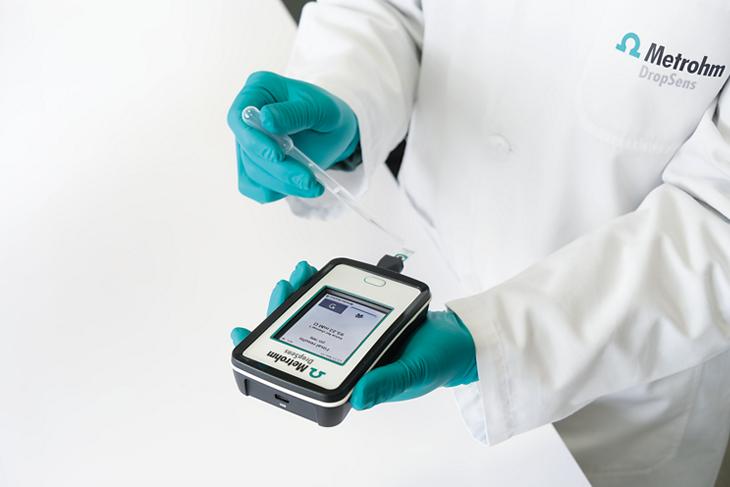
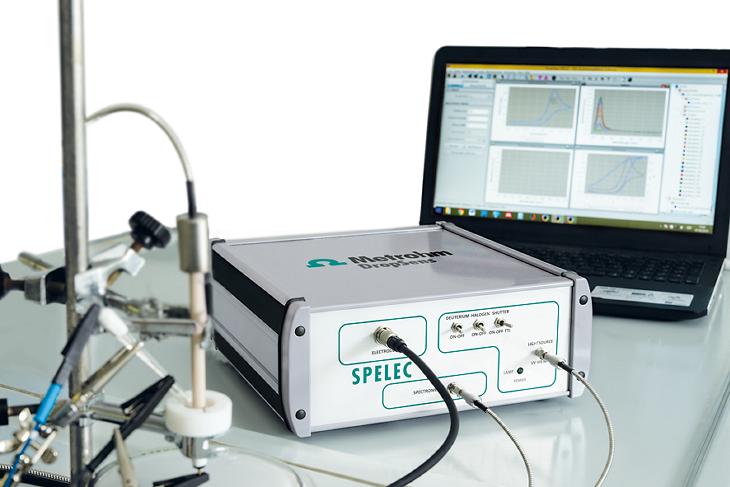
เครื่องมือวิเคราะห์เคมีไฟฟ้าจากปฏิกิริยาเรืองแสงจะประกอบไปด้วย เครื่อง bipotentiostat/galvanostat ซึ่งเป็นตัวทำให้สารเรืองแสงเกิดปฏิกิริยาด้วยศักย์ไฟฟ้าหรือกระแสไฟฟ้า จากนั้นจะวัดการเปล่งแสงที่เกิดขึ้นด้วยตัวตรวจวัด แบบ photodiode หรือ micro spectrometer เครื่อง Metrohm Dropsens มีขนาดเล็กและสะดวกต่อการเคลื่อนย้ายจึงเหมาะเป็นอย่างยิ่งสำหรับงานวิเคราะห์เคมีไฟฟ้าจากปฏิกิริยาเรืองแสง

ตัวเครื่องมือสามารถใช้งานเป็นเครื่อง bipotentiostat และ Galvanostat เพื่อวิเคราะห์ทางเคมีไฟฟ้าได้โดยมีประสิทธิภาพ

การเชื่อมต่อทันที

เคมีไฟฟ้าและการเปล่งแสงจากปฏิกิริยาเคมีจะเชื่อมต่อเข้าด้วยกันและแสดงผลในเวลาเดียวกัน มากไปกว่านั้นเครื่อง Metrohm Dropsens ยังสามารถใช้งานได้ในสภาวะที่แสงมีสัญญานต่ำมากได้

เครื่อง potentiostat/galvanostat รุ่นใดที่ตรงกับความต้องการของคุณ?

พูดคุยกับตัวแทนจาก Metrohm และเรียนรู้เกี่ยวกับเครื่องมือที่ดีที่สุดตามความต้องการของคุณ!

ECL processes involve a luminophore, a co-reactant, and electrochemistry.

  • The luminophore is the key light-emitting molecule responsible of the emission of light during the ECL reaction. It provides the sensitivity, specificity, and efficiency of the ECL system. Its selection is critical to the development of new applications.
  • The co-reactant plays a crucial role in the generation of the excited states of the luminophore. Its primary function is to participate in the electrochemical reaction close to the electrode surface, generating reactive intermediates that interact with the luminophore.
  • Electrochemistry enables the oxidation and/or reduction of the luminophore and co-reactants at the electrode surface. These reactions are essential for the formation of the reactive species required for ECL.

ECL typically follows these steps:

  1. Electrochemical application of a potential/current to the working electrode.
  2. Generation of reactive intermediates via redox reactions of the luminophore or the co-reactant.
  3. Formation of an excited state close to the electrode surface upon interaction of intermediates.
  4. Emission of light when the excited state returns to the ground state.

Electrochemiluminescence offers the following advantages:

  • High sensitivity: ECL allows the detection of very low concentrations of analytes, making it ideal for applications such as medical diagnostics and environmental monitoring.
  • Excellent specificity: Combined with specific recognition elements (e.g., antibodies or DNA probes), ECL ensures high selectivity in detecting target molecules.
  • Wide dynamic range: It can measure analyte concentrations over several orders of magnitude, accommodating both very low and high levels of detection.
  • Minimal background noise: Since the luminescence signal is generated electrochemically, ECL exhibits lower background interference compared to other luminescent methods.
  • Versatility: It is compatible with a wide range of molecules and analytes, from small compounds to large biomolecules like proteins and nucleic acids.
  • Speed and reproducibility: The technique provides rapid results with high reproducibility, essential for high throughput testing.
  • Robustness: The reagents and setups are generally stable, ensuring reliable performance over time.

Its unique properties make electrochemiluminescence highly versatile:

  • Biosensing and medical diagnostics: ECL is widely used in clinical and biomedical research for detecting biomolecules with high sensitivity and specificity.
  • Pharmaceutical and drug development: ECL is utilized in pharmaceutical research for the development of drugs and quality control.
  • Food safety and environmental monitoring: ECL plays a crucial role in the detection of contaminants and monitoring of environmental safety.
  • Material science and nanotechnology: ECL is used in the characterization of novel materials and in the design of advanced sensors.
  • Clinical research: ECL platforms are used in the development of personalized therapeutic strategies. 
  • Analytical chemistry: ECL is a key technique in the detection and quantification of trace levels of analytes.
  • Forensic science: ECL is used to detect traces of substances such as drug residues and explosive materials.

The following luminophores are mostly used:

  • Ruthenium complexes (e.g., Ru(bpy)32+) are widely used in biosensing due to their high stability and strong luminescence.
  • Luminol is often used in forensic science and environmental testing.
  • Quantum dots and nanomaterials offer tunable luminescence and enhanced performance in advanced ECL applications.
Explore Metrohm potentiostats/galvanostats