Boli ste presmerovaní na lokálnu verziu požadovanej stránky
Elektrochemiluminiscencia: nová úroveň optickej senzitivity

Elektrochemiluminiscencia: nová úroveň optickej senzitivity

Nová úroveň optickej senzitivity: všestrannosť, jednoduchosť a zlepšená synchronizácia a citlivosť pre analytickú techniku ECL.

Elektrochemiluminiscencia: nová úroveň optickej senzitivity

sk

Nová úroveň optickej senzitivity: všestrannosť, jednoduchosť a zlepšená synchronizácia a citlivosť pre analytickú techniku ECL.

Elektrochemiluminiscencia je kombináciou elektrochémie a chemiluminiscencie. Elektrochemicky generované chemiluminiscenčné signály sa zvyčajne získavajú z excitovaných stavov luminofóru generovaného na povrchu elektródy počas elektrochemickej reakcie. Elektrogenerovaná chemiluminiscencia sa bežne používa na potravinovú a klinickú analýzu.

  • Kompaktné a všestranné riešenia
  • Prenosné systémy so zjednodušeným optickým nastavením
  • Zvýšená citlivosť testovania
  • Okamžitá synchronizácia dát
  • Obsahuje pokročilé cely na prácu so screen-printed elektródami
  • Softvér so špeciálnymi funkciami pre štúdie ECL

Robustný, prenosný a všestranný

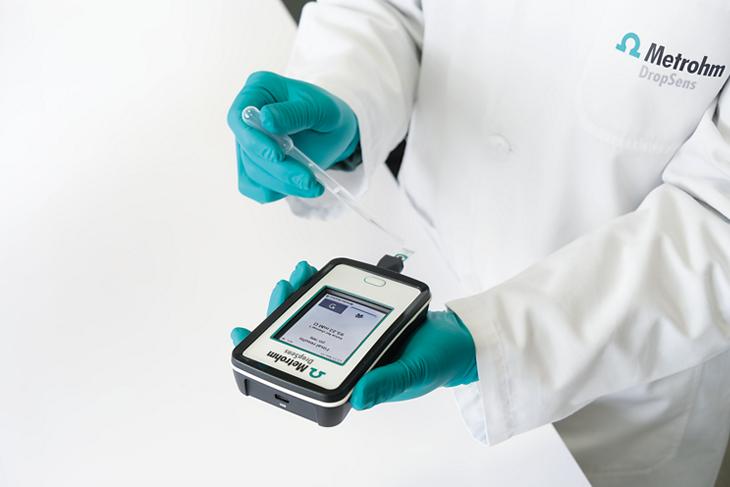
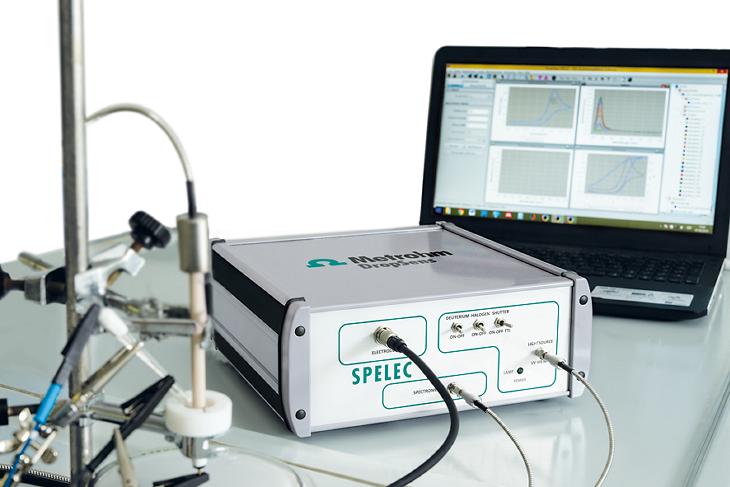
Elektrochemiluminiscenčné systémy pozostávajú z bipotenciostatu/galvanostatu schopného vyvolať reakcie v luminofóre, aplikáciou napäťových alebo prúdových impulzov. Stav luminofóru je zisťovaný pomocou cely, ktorá obsahuje detektor (fotodióda alebo mikrospektrometer, v závislosti od modelu). Systémy Metrohm DropSens sú miniaturizované a prenosné – ideálne pre elektrogenerovanú chemiluminiscenčnú (ECL) analýzu.

Prístroje možno použiť aj samostatne ako bipotenciostat/galvanostat na elektrochemickú analýzu so všetkými funkciami prístrojov Metrohm DropSens. V závislosti od prístroja ECL je možné bunky kombinovať.

Okamžitá synchronizácia

Elektrochemické a chemiluminiscenčné odozvy sú dokonale synchronizované a zobrazené v reálnom čase. Prístroje Metrohm DropSens navyše umožňujú dobrú časovú a priestorovú kontrolu týchto analytických techník, aj keď je citlivosť na svetelné signály veľmi nízka.

Ktorý potenciostat/galvanostat vyhovuje vašim požiadavkám?

Porozprávajte sa so svojím zástupcom Metrohm a získajte informácie o najvhodnejšom riešení pre vaše potreby!

ECL processes involve a luminophore, a co-reactant, and electrochemistry.

  • The luminophore is the key light-emitting molecule responsible of the emission of light during the ECL reaction. It provides the sensitivity, specificity, and efficiency of the ECL system. Its selection is critical to the development of new applications.
  • The co-reactant plays a crucial role in the generation of the excited states of the luminophore. Its primary function is to participate in the electrochemical reaction close to the electrode surface, generating reactive intermediates that interact with the luminophore.
  • Electrochemistry enables the oxidation and/or reduction of the luminophore and co-reactants at the electrode surface. These reactions are essential for the formation of the reactive species required for ECL.

ECL typically follows these steps:

  1. Electrochemical application of a potential/current to the working electrode.
  2. Generation of reactive intermediates via redox reactions of the luminophore or the co-reactant.
  3. Formation of an excited state close to the electrode surface upon interaction of intermediates.
  4. Emission of light when the excited state returns to the ground state.

Electrochemiluminescence offers the following advantages:

  • High sensitivity: ECL allows the detection of very low concentrations of analytes, making it ideal for applications such as medical diagnostics and environmental monitoring.
  • Excellent specificity: Combined with specific recognition elements (e.g., antibodies or DNA probes), ECL ensures high selectivity in detecting target molecules.
  • Wide dynamic range: It can measure analyte concentrations over several orders of magnitude, accommodating both very low and high levels of detection.
  • Minimal background noise: Since the luminescence signal is generated electrochemically, ECL exhibits lower background interference compared to other luminescent methods.
  • Versatility: It is compatible with a wide range of molecules and analytes, from small compounds to large biomolecules like proteins and nucleic acids.
  • Speed and reproducibility: The technique provides rapid results with high reproducibility, essential for high throughput testing.
  • Robustness: The reagents and setups are generally stable, ensuring reliable performance over time.

Its unique properties make electrochemiluminescence highly versatile:

  • Biosensing and medical diagnostics: ECL is widely used in clinical and biomedical research for detecting biomolecules with high sensitivity and specificity.
  • Pharmaceutical and drug development: ECL is utilized in pharmaceutical research for the development of drugs and quality control.
  • Food safety and environmental monitoring: ECL plays a crucial role in the detection of contaminants and monitoring of environmental safety.
  • Material science and nanotechnology: ECL is used in the characterization of novel materials and in the design of advanced sensors.
  • Clinical research: ECL platforms are used in the development of personalized therapeutic strategies. 
  • Analytical chemistry: ECL is a key technique in the detection and quantification of trace levels of analytes.
  • Forensic science: ECL is used to detect traces of substances such as drug residues and explosive materials.

The following luminophores are mostly used:

  • Ruthenium complexes (e.g., Ru(bpy)32+) are widely used in biosensing due to their high stability and strong luminescence.
  • Luminol is often used in forensic science and environmental testing.
  • Quantum dots and nanomaterials offer tunable luminescence and enhanced performance in advanced ECL applications.
Prehľad Metrohm potenciostatov/galvanostatov