Du er blevet omdirigeret til din lokale version af den anmodede side
Elektrokemiluminescens: det næste niveau i optisk følsomhed

Elektrokemiluminescens: det næste niveau i optisk følsomhed

Alsidighed, enkelhed og forbedret synkronisering og følsomhed for den analytiske ECL-teknik.

Elektrokemiluminescens: det næste niveau i optisk følsomhed

da

Alsidighed, enkelhed og forbedret synkronisering og følsomhed for den analytiske ECL-teknik.

Elektrokemiluminescens er kombinationen af elektrokemi og kemiluminescens. Elektrogenererede kemiluminescenssignaler opnås sædvanligvis fra de exciterede tilstande af en luminophor genereret ved elektrodeoverfladen under den elektrokemiske reaktion. Elektrogenereret kemiluminescens er blevet anvendt i vid udstrækning til fødevarer og kliniske analyser.

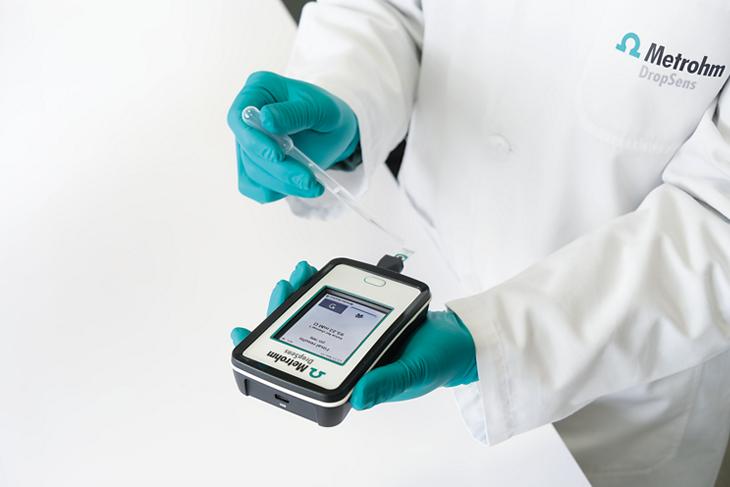
Metrohm DropSens tilbyder miniaturiserede og bærbare elektrokemiluminescensinstrumenter bestående af en bipotentiostat/galvanostat i kombination med en ECL-celle: 

  • Kompakte og alsidige løsninger
  • Bærbare systemer med forenklet optisk opsætning
  • Øget testfølsomhed
  • Øjeblikkelig datasynkronisering
  • Avancerede celler inkluderet for at arbejde med screenprintede elektroder
  • Software med dedikerede funktionaliteter til ECL-undersøgelser

Robust, bærbar og alsidig

Elektrokemiluminescenssystemer består af en bipotentiostat/galvanostat, der er i stand til at producere reaktioner i en luminophor ved at påføre spændings- eller strømimpulser. Tilstanden af luminophoren detekteres af en celle, der inkluderer detektoren (en fotodiode eller mikrospektrometer, afhængigt af modellen). Metrohm DropSens-systemerne er miniaturiserede og bærbare - perfekt til elektrogenereret kemiluminescens (ECL) analyse.

Instrumenterne kan også bruges selvstændigt som bipotentiostat/galvanostat til elektrokemisk analyse med alle funktionerne fra Metrohm DropSens instrumenter. Afhængigt af ECL-instrumentet kan cellerne kombineres.

Øjeblikkelig synkronisering

Elektrokemiske og kemiluminescensresponser er perfekt synkroniserede og vises i realtid. Desuden tillader Metrohm DropSens-instrumenterne god tidsmæssig og rumlig kontrol af disse analytiske teknikker, selv når følsomheden over for lyssignaler er meget lav.

Hvilken potentiostat/galvanostat passer til dine behov?

Kontakt din Metrohm-specialist for at lære mere om de bedste løsninger!

ECL processes involve a luminophore, a co-reactant, and electrochemistry.

  • The luminophore is the key light-emitting molecule responsible of the emission of light during the ECL reaction. It provides the sensitivity, specificity, and efficiency of the ECL system. Its selection is critical to the development of new applications.
  • The co-reactant plays a crucial role in the generation of the excited states of the luminophore. Its primary function is to participate in the electrochemical reaction close to the electrode surface, generating reactive intermediates that interact with the luminophore.
  • Electrochemistry enables the oxidation and/or reduction of the luminophore and co-reactants at the electrode surface. These reactions are essential for the formation of the reactive species required for ECL.

ECL typically follows these steps:

  1. Electrochemical application of a potential/current to the working electrode.
  2. Generation of reactive intermediates via redox reactions of the luminophore or the co-reactant.
  3. Formation of an excited state close to the electrode surface upon interaction of intermediates.
  4. Emission of light when the excited state returns to the ground state.

Electrochemiluminescence offers the following advantages:

  • High sensitivity: ECL allows the detection of very low concentrations of analytes, making it ideal for applications such as medical diagnostics and environmental monitoring.
  • Excellent specificity: Combined with specific recognition elements (e.g., antibodies or DNA probes), ECL ensures high selectivity in detecting target molecules.
  • Wide dynamic range: It can measure analyte concentrations over several orders of magnitude, accommodating both very low and high levels of detection.
  • Minimal background noise: Since the luminescence signal is generated electrochemically, ECL exhibits lower background interference compared to other luminescent methods.
  • Versatility: It is compatible with a wide range of molecules and analytes, from small compounds to large biomolecules like proteins and nucleic acids.
  • Speed and reproducibility: The technique provides rapid results with high reproducibility, essential for high throughput testing.
  • Robustness: The reagents and setups are generally stable, ensuring reliable performance over time.

Its unique properties make electrochemiluminescence highly versatile:

  • Biosensing and medical diagnostics: ECL is widely used in clinical and biomedical research for detecting biomolecules with high sensitivity and specificity.
  • Pharmaceutical and drug development: ECL is utilized in pharmaceutical research for the development of drugs and quality control.
  • Food safety and environmental monitoring: ECL plays a crucial role in the detection of contaminants and monitoring of environmental safety.
  • Material science and nanotechnology: ECL is used in the characterization of novel materials and in the design of advanced sensors.
  • Clinical research: ECL platforms are used in the development of personalized therapeutic strategies. 
  • Analytical chemistry: ECL is a key technique in the detection and quantification of trace levels of analytes.
  • Forensic science: ECL is used to detect traces of substances such as drug residues and explosive materials.

The following luminophores are mostly used:

  • Ruthenium complexes (e.g., Ru(bpy)32+) are widely used in biosensing due to their high stability and strong luminescence.
  • Luminol is often used in forensic science and environmental testing.
  • Quantum dots and nanomaterials offer tunable luminescence and enhanced performance in advanced ECL applications.

Find applikationer til Elektrokemi

Udforsk Metrohm potentiostater/galvanostater