Søg


- AN-FLU-001Fluorescence spectroelectrochemistry of [Ru(bpy)3]2+/3+ in semi-infinite diffusion regime
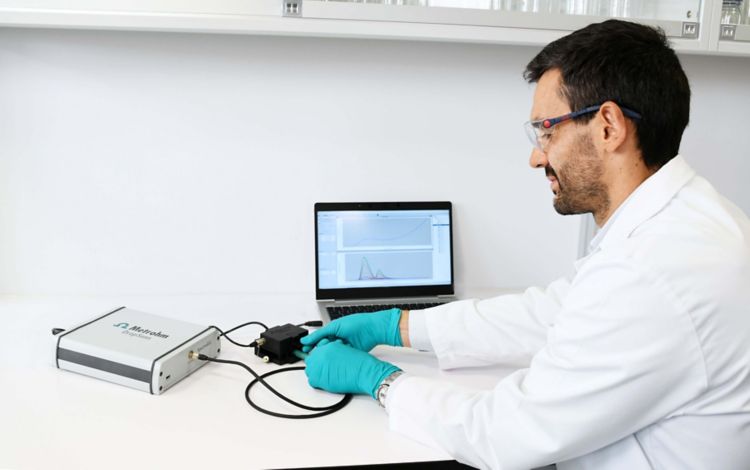
In this Application Note, the Metrohm DropSens SPELEC instrument is used with the FLUORESCENCE KIT for time-resolved monitoring of electrochemical reactions in a semi-infinite diffusion regime by performing fluorescence spectroelectrochemistry of the [Ru(bpy)3]2+/3+ redox couple.
- AN-V-231Cadmium and lead in drinking water with screen-printed carbon electrodes
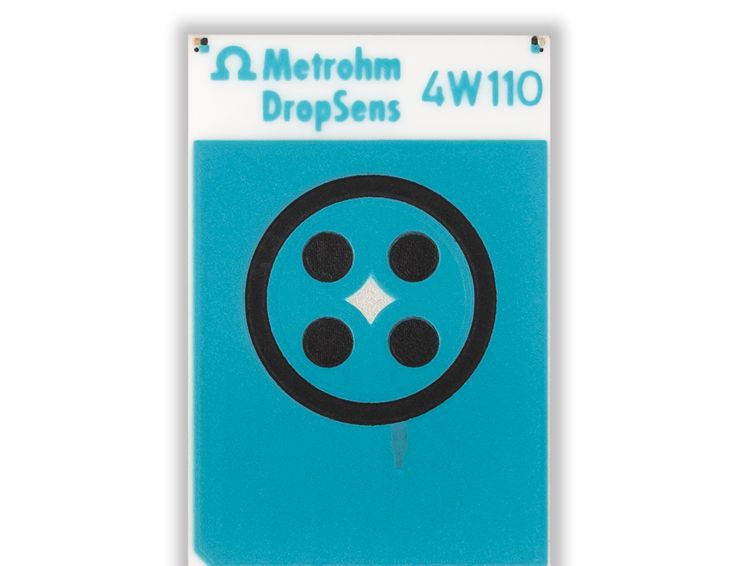
The provisional guideline values in the World Health Organization’s (WHO) «Guidelines for Drinking-water Quality» are set to 3 µg/L for cadmium and 10 µg/L for lead. The anodic stripping voltammetry (ASV) technique performed on the ex-situ mercury film modified Metrohm DropSens screen-printed electrode (SPE) can be used to simultaneously detect concentrations as low as 0.3 µg/L for both elements. This is suitable to monitor the WHO guideline values. The main advantage of this method lies in the innovative and cost-effective screen-printed electrode.
- AN-FET-001Characterization and performance studies of field-effect transistors (FETs) using μStat-i 400
In recent years, field-effect transistors (FETs) have become more commonly used as a sensing platform for a multitude of electrochemical and biological applications. These devices are promising bioelectronic transducers that allow both low-potential operation and stable potentiometric measurements. FETs are now seen as an attractive alternative to using conventional electrochemical detection systems in the scientific community. This Application Note gives in-depth guidance about how to operate Metrohm DropSens bipotentiostat devices for the characterization of FETs and their use as transducers. A single μStat-i 400 device, a small and portable bipotentiostat and galvanostat, is used to demonstrate the experiments.
- AN-RA-002The carbon battle characterization of screen-printed carbon electrodes with SPELEC RAMAN
Carbon materials are a remarkable choice as electrode surfaces. They are not only cost-effective and chemically inert, but also have a low background current and a wide potential window. Physical and chemical properties of new carbon nanomaterials depend mainly on their structure, so their characterization is essential to choose the right material for different applications.Raman spectroscopy is a very attractive technique for this purpose, effortlessly distinguishing information about the bond structure of carbon materials, and, therefore, about their possible properties. DropSens screen-printed electrodes (SPEs) are low-cost, disposable devices, available with working electrodes fabricated in several carbon materials. This Application Note describes how their properties can be studied by Raman spectroscopy.
- AN-V-232Nickel and cobalt in drinking water with screen-printed carbon electrodes
EU legislation specifies 20 µg/L as the limit value for nickel in drinking water. The current provisional guideline value for Ni in the World Health Organization’s «Guidelines for Drinking-water Quality» is set to a maximum concentration of 70 µg/L. The adsorptive stripping voltammetry (AdSV) technique performed on the ex-situ bismuth film modified Metrohm DropSens 11L screen-printed electrode (SPE) can be used to simultaneously detect concentrations as low as 0.4 µg/L for nickel and 0.2 µg/L for cobalt with a 30 s deposition time.The disposable, maintenance-free sensor can be used conventionally in the laboratory with the 884 Professional VA, or alternatively in the field with the 946 Portable VA Analyzer. This method is best suited for manual systems.
- WP-058Virus detection: Fast, sensitive, and cost-effective with electrochemical testing
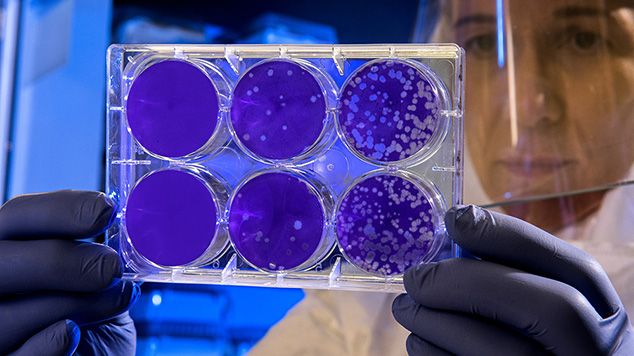
With significant global viral outbreaks becoming the norm rather than generational outliers, it is imperative that fast, sensitive, and cost-effective testing is available to the masses. Screen-printed electrodes (SPEs) allow rapid, widespread testing of populations for infectious disease, without the need of skilled personnel or burdensome equipment in the field. The possibility of point-of-care (POC) testing with SPEs has been exhibited in several recent studies. Metrohm DropSens combines high production capabilites of custom-made SPEs with a valid ISO 13485 certification "Manufacturing of sensors for medical devices", meaning testing procedures developed on these SPEs can be reliably scaled up for larger operations, with easier regulatory approval for commercialization.
- AN-EC-034Ion-selective electrodes based on screen-printed technology
Advances in polymeric membranes and screen-printed technologies have enabled miniaturized, portable potentiometric sensors ideal for point-of-care analysis.
- AN-RA-009Comparison of SPELEC RAMAN and standard Raman microscopes
This Application Note compares SPELEC RAMAN and a standard Raman instrument by analyzing their performance in measuring single-walled carbon nanotubes (SWCNT).
- AN-RS-042Revealing battery secrets with EC-Raman solutions
Electrochemical Raman (EC-Raman) spectroscopy enhances comprehension of energy storage devices by tracking physicochemical changes. This note details EC-Raman findings during nickel-metal hydride (NiMH) battery charge and discharge simulations.
- AN-EC-038Measuring ionic conductivity using screen-printing technology
Using disposable 11COND screen printed electrodes and electrochemical impedance spectroscopy, conductivity in drinking water can be measured using only 100 µL samples.
- AN-EC-035Using a portable standalone system for easy fermentation monitoring
By using an enzymatic sensor with a screen-printed electrode, producers can measure lactic acid production, thereby monitoring fermentation processes.
- AN-EC-032Hydrogen permeation with a single instrument according to ASTM G148
The Devanathan-Stachurski cell (or «H cell») is successfully used to evaluate the permeation of hydrogen through sheets or membranes. As small amounts of hydrogen pass through the sheet or membrane, a very sensitive potentiostat is required for its detection. A study of the hydrogen permeation properties of different iron sheets is discussed in this Application Note while taking the instrumental requirements into account.
- AN-SEC-003UV-Vis spectroelectrochemical cell for conventional electrodes
The development of a novel reflection cell for conventional electrodes facilitates the performance of spectroelectrochemical measurements. This device allows researchers to work in aqueous solutions as well as in organic media due to its chemical resistance.


.mp4?$xh-730$&bfc=on)