You have been redirected to your local version of the requested page

Privacy Policy

I allow Metrohm AG and its subsidiaries and exclusive distributors to store and process my data in accordance with its Privacy Policy and to contact me by e-mail, telephone, or letter to reply to my inquiry and for advertising purposes. I can withdraw this consent at any time by sending an e-mail to info@metrohm.com.

This field is required.

Choosing the right eluent in chromatography is crucial—especially for ion exchange chromatography (also known as ion chromatography or IC)—as is the choice of the correct column. Both must work in harmony to achieve optimal separation performance. In chromatography, we often refer to the «triangle of dependency» – the interdependent relationship between analytes, the stationary phase, and the eluent. This blog post focuses on the eluent-part of this triangle by discussing the role of eluents (mobile phases) in IC, which types of eluents are used, and what to consider when choosing and preparing an eluent for your specific application.

The «triangle of dependency»

Figure 1 illustrates how this concept applies specifically to ion chromatography. Each of the three components—analytes, stationary phase, and eluent—plays a crucial and interconnected role in the separation process. Changing one component influences the others. If the balance between them is disrupted, it can negatively affect peak resolution, analyte retention, and overall method performance.

Understanding this triangle is essential for developing effective ion chromatography methods. It provides a simple framework for troubleshooting and optimizing the separation strategy for specific analytical challenges. Knowing the properties of the eluent that can affect analyte separation is crucial. This allows you to use these properties to your advantage and achieve the best possible performance in your IC analysis.

Figure 1. Triangle of dependency in ion chromatography (adapted from [1]).

What is the eluent in ion chromatography?

Figure 2. Illustration of the flow path of an anion IC.

In chromatography, the eluent (mobile phase) is the liquid solution that transports the analytes through the separation column (stationary phase) (Figure 2). Before entering the high-pressure pump, the eluent is degassed using an eluent degasser. It then flows through an injector (6/2 injector shown) before it is pumped through the column. The analytes are detected after passing through the column.

Suppression in ion chromatography is used to eliminate conductivity influences from the eluent. It lowers background noise to a minimum, allowing a higher signal-to-noise ratio for the resulting peaks. This suppression step occurs between the column and the detector.

The eluent plays a crucial role in the separation of the analytes based on their interactions with the column. In ion chromatography, the eluent is usually based on acids, bases, or salts. The specific composition depends on the charge of the ion to be separated. For anion analysis, the eluent is usually based on mixtures of sodium carbonate / sodium bicarbonate, sodium hydroxide, or potassium hydroxide. Eluents for cation analysis are usually based upon low concentrations of nitric acid, sulfuric acid, or methanesulfonic acid.

As with all liquid chromatography separations, the IC mobile phase is the easiest parameter to change to influence analyte separation. In contrast, the column and the detection system are in most cases predefined. 

Privacy Policy

I allow Metrohm AG and its subsidiaries and exclusive distributors to store and process my data in accordance with its Privacy Policy and to contact me by e-mail, telephone, or letter to reply to my inquiry and for advertising purposes. I can withdraw this consent at any time by sending an e-mail to info@metrohm.com.

This field is required.

Considerations for choosing and preparing an eluent in ion chromatography

The choice of a suitable eluent can be made by using a wide range of criteria. The following parameters must be considered, among others [1–8]: 

Eluent preparation

Only the highest quality chemicals should be used to prepare eluents for ion chromatography. Contamination from other ions will have a direct effect on the peak separation and the conductivity measured. Therefore, using lower purity reagents negatively affects the quantification of the target analytes.

Additionally, for dilution of these chemicals, only ultrapure water (Type 1) must be used. 

After preparation, fresh eluents are often microfiltered (0.2 µm) to remove unwanted particles. These can accumulate at the entrance of the column and hence reduce its lifetime. Additionally, IC systems can be equipped with aspiration and inline filters that help to keep particles from entering the eluent stream.

Degassing the eluent is necessary, as air bubbles directly impact the detection signal. This can be either done by manually vacuum degassing the eluent prior to the measurement or using an inline eluent degasser in the flow path of the instrument (Figure 2). 

Preparation consistency

It is necessary to store the eluents properly for use after preparation, thorough mixing, and degassing them. For eluents that don't react with ambient carbon dioxide, bottles are sealed with eluent caps and dust-absorbing filters. However, for alkaline eluents with low buffering capacity that can react with CO2 from the ambient air, using CO2 absorbers is essential (see absorber connected to the eluent bottle in Figure 2). 

Detection method compatibility

The eluent should not interfere with the detection method, e.g., high baseline conductivity, high UV absorbance at the same wavelength as the analyte, or reaction with the analytes of interest. This ensures the best possible baseline stability, reproducibility of the retention times, and sensitivity [4].

Chemical reactivity and concentration of the eluent ion 

Chemicals used for the eluent should not create undesired reactions with the stationary phase and must be chemically stable to avoid interference or degradation during the analysis [5]. Therefore, it is necessary to know the properties of the stationary phase. Manufacturers often describe the standard conditions as well as the limitations of the stationary phase—for example, the suitable pH range or the addition of organic modifiers.


Read our related blog post to learn more about choosing an IC column and optimizing the analyte separation.

Best practice for separation columns in ion chromatography (IC) – Part 2

How eluent composition affects analyte separation

The composition of the eluent directly influences the separation of the target ions since it affects their retention times. The most important factors to consider are mentioned below.

In IC, an increase in the eluent concentration often leads to shorter retention times and quicker separation. However, this results in a higher background conductivity.

For overloaded analyte peaks (high matrix concentration), the weaker retention of the eluent ions (higher concentrations of eluent) as compared to the overloaded analyte peak can lead to peak tailing (Figure 3), while stronger retention of the eluent ion (lowered concentrations of eluent) can lead to peak fronting (Figure 4). 

Take the chloride peak in seawater as an example. For peak fronting, the overload chloride peak shifts earlier towards the organic acids and traces of oxohalogenides in front of chloride. For peak tailing, the overload chloride peak shifts later towards nitrite and bromide [6].

Figure 3. Effect on the peak shape (fronting or tailing) of overload bromide peaks (0.1, 1, 10, 100, 300, and 500 mmol/L bromide) with different concentrations of sodium hydroxide eluents. Figure adapted from Wahab et al. [6].
Figure 4. Effect on the peak shape (fronting or tailing) of overload bromide peaks (0.1, 1, 10, 100, 300, and 500 mmol/L bromide) with different concentrations of carbonate/hydrogen carbonate eluents. Figure adapted from Wahab et al. [6].

Figure 5. pH influence of the eluent on the retention time of common anions (1. fluoride, 2. chloride, 3. nitrite, 4. bromide, 5. nitrate, 6. phosphate, and 7. sulfate) with the Metrosep A Supp 19 - 150/4.0 column using the standard carbonate eluent [10].

Alterations to eluent pH lead to shifts in the dissociation equilibrium of the analyte, therefore changing the analyte’s retention time (Figure 5).

The pH must be kept within a range that prevents degradation or alteration of the stationary phase, especially for silica-based columns, which are sensitive to extreme pH conditions [7,9].

Furthermore, detection methods like conductivity and UV absorption are sensitive to pH changes. A fixed pH minimizes baseline noise and enhances detection sensitivity [8]. 

Our recommendation for ion separation is to initially isolate monovalent ions, followed by multivalent ions. Introducing multivalent ions amidst monovalent ions by increasing the eluent strength or by modifying the eluent pH poses significant risks. These separations (and therefore the peak resolution) are particularly susceptible to column aging and batch-to-batch variations.

Buffers stabilize the pH of a solution. An appropriate buffer ensures reliable, accurate, and reproducible results by maintaining a stable pH environment. This is especially relevant for analytes like acids and bases. Their charge depends on the acid/base dissociation constant, which is affected by the pH of the eluent [1]. 

Dissociation constants are also influenced by temperature. Therefore, temperature changes influence the retention time, especially for acids and bases. A column oven can stabilize the temperature conditions and ensure stable measurements.

When using carbonate eluents at higher temperatures, a V-shape effect occurs where monovalent anions elute earlier and multivalent anions elute later (Figure 6). For hydroxide eluents, this effect is known as the hydroxide tilted V-shape effect (Figure 7) because all ions elute later, particularly multivalent anions. 

Figure 6. V-shape effect of temperature on the retention time of common anions (1. fluoride, 2. chloride, 3. nitrite, 4. bromide, 5. nitrate, 6. phosphate, and 7. sulfate) with the Metrosep A Supp 19 - 150/4.0 column using the standard carbonate eluent [10].
Figure 7. Hydroxide tilted V-shape effect of temperature on the retention time of common anions (1. fluoride, 2. chloride, 3. nitrite, 4. bromide, 5. nitrate, and 6. sulfate) with the Metrosep A Supp 19 - 150/4.0 column using a 30 mmol/L hydroxide eluent.

Figure 8. Effects of organic modifier (methanol) usage on the retention time of common anions (1. fluoride, 2. chloride, 3. nitrite, 4. bromide, 5. nitrate, 6. sulfate, and 7. Phosphate) with the Metrosep A Supp 19 - 150/4.0 column using a carbonate eluent [10].

Addition of an organic solvent (e.g., methanol, acetone, or acetonitrile) to aqueous eluents generally has little influence on the retention time of non-polarizable ions (e.g., fluoride, chloride, sodium, calcium, etc.). Polarizable and less hydrophilic ions (e.g., iodide, thiocyanate, organic ammonium cations, etc.) typically elute earlier with the use of an organic modifier.

Furthermore, organic modifiers are often used to increase the ionization inside the electrospray ionization source when an ion chromatograph is coupled with a mass spectrometer.

In ion chromatography, cation retention times can be modified by adding complexing agents to the eluent [3,11]. The complexing agent serves as a ligand with the analyte cation functioning as the central metal ion. The more selective a ligand is with respect to a central metal ion, the stronger the influence it has on the retention time. In ideal scenarios, the retention times of the other cations will only alter slightly. 

Commonly used complexing agents include crown ethers and dicarboxylic acids such as oxalic acid, dipicolinic acid, and tartaric acid.

18-Crown-6-ether

Complexing agents are used to obtain better separation of alkali metal ions. Adding 18-crown-6-ether (1,4,7,10,13,16-hexaoxacyclooctadecane) to the eluent leads to better separation between Na+, NH4+, and K+. This modification is useful, for example, to improve the determination of trace NH4 + content in natural water samples with a high K+ load.

Figure 9 shows how the retention time of K+  significantly increases following the addition of 18-crown-6-ether to the eluent (Table 1). This can be explained by the formation of the K+-18-crown-6-ether-complex as shown in Figure 10, which is considerably larger. The retention time of potassium increases because of the steric hindrance, and with that, the distance from NH4+. There will be no inference with ammonium even at high potassium concentrations.

Figure 9. Overlaid chromatograms with common cations (lithium, sodium, ammonium, potassium, calcium, and magnesium) showcasing the effect of adding 18-crown-6-ether (in orange) to the eluent [3,11].
Table 1. Effects of using 18-crown-6-ether eluent modifier on the retention time (RT) of various cations (10 mg/L each).
Peak Component RT [min] RT [min] (18-crown-6)
1 Lithium 4.31 4.25
2 Sodium 5.60 5.61
3 Ammonium 6.28 6.42
4 Potassium 8.46 10.39
5 Calcium 17.47 17.00
6 Magnesium 20.78 20.00
Figure 10. Structure of 18-crown-6-ether with the potassium ion in the middle. The potassium ion fits exactly in the «cage» of the ether. It is complexed via the electron pairs of the oxygen atoms.

Dicarboxylic acids

Dicarboxylic acids form complexes with many divalent cations. Typically, these complexes have a reduced charge. As a result, when dicarboxylic acids are added to the eluent, multivalent cations are retained less strongly and elute earlier. The extent of this acceleration is influenced by the complexation constant of the specific cation complex.

Figure 11 shows this effect on magnesium, calcium, and zinc when using dipicolinic acid (also known as pyridine-2,6-dicarboxylic acid, PDC, or DPA) as an eluent modifier. Compared to calcium or magnesium, the transition metal zinc forms a much stronger complex with dipicolinic acid. As a result, it is heavily influenced even by low concentrations of this complexing agent. Zinc already elutes before lithium in chromatogram b), and it is totally complexed and elutes with the injection peak in c). Calcium is weakly complexed with dipicolinic acid, but its complex is stronger than with magnesium. The resolution of magnesium and calcium is reduced in chromatogram b), while in c) calcium already elutes before magnesium. This modifier is applied to reduce the run time of determinations analyzing calcium and magnesium besides alkali metal cations.

Figure 11. Chromatograms showing the separation of 1. sodium, 2. potassium, 3. magnesium, 4. zinc, and 5. calcium when using different amounts of dipicolinic acid modifier in the eluent: a) 0 mol/L, b) 0.1 mmol/L, c) 0.7 mmol/L [11].
Table 2. Effects of using dipicolinic acid eluent modifier on the retention time (RT) of various cations (10 mg/L each).
Peak Component RT [min] (a) RT [min] (b) RT [min] (c)
1 Sodium 6.79 6.50 5.39
2 Potassium 10.42 9.93 8.08
3 Magnesium 33.05 29.90 19.05
4 Zinc 38.24 3.38
5 Calcium 44.48 35.87 16.08

Automatic eluent preparation

After you have found the specific eluent that fits your separation needs, you can consider automation. There are several ways to automate eluent preparation. One of which is preparing an eluent stock (concentrate) from which you can easily dilute the exact eluent concentration automatically. Concentrates are available from Merck for all standard eluents of Metrohm columns. These eluent concentrates can be automatically diluted with e.g., a 941 Eluent Production Module.

Additionally, for hydroxide eluents such as NaOH, KOH, or LiOH, the 948 Continuous IC Module, CEP is an ideal choice. This module can continuously prepare hydroxide eluents electrolytically using a hydroxide concentrate. 

Figure 12. Stacked results of 200 injections of common anions (fluoride, chloride, nitrite, bromide, nitrate, sulfate, and phosphate) using an eluent gradient prepared by the 948 Continuous IC Module, CEP.

The benefits of automation are:

  1. Reliability – no manual preparation nor labor needed
  2. Higher reproducibility and robustness of the separation
  3. Better performance due to lower baseline conductivity and less variability

Conclusion

Eluents are one key part of the triangle of dependency in ion chromatography. The correct preparation steps, chemical reagents used, and many other variables are essential to consider before preparing an eluent. The proper choice and preparation of the eluent is crucial for a reliable, robust ion chromatography measurement.

To broaden your knowledge of ion chromatography, download our monographs below and start working with your IC instrument. 

[1] Kromidas, S. The HPLC Expert; Wiley-VCH: Weinheim, 2016.

[2] Haddad, P. R.; Jackson, P. E. Ion Chromatography; Journal of Chromatography Library; Elsevier: Amsterdam, 1990.

[3] Schäfer, H.; Läubli, M. Monograph: Ion Chromatography; Metrohm AG: Herisau, Switzerland, 2023. https://www.metrohm.com/en/products/8/1085/81085077.html

[4] Liu, Y.; Kaiser, E.; Avdalovic, N. Determination of Trace-Level Anions in High-Purity Water Samples by Ion Chromatography with an Automated On-Line Eluent Generation System. Microchemical Journal 1999, 62 (1), 164–173. DOI:10.1006/mchj.1999.1699

[5] Zou, J.; Motomizu, S.; Fukutomi, H. Reversed-Phase Ion-Interaction Chromatography of Inorganic Anions with Tetraalkylammonium Ions and Divalent Organic Anions Using Indirect Photometric Detection. Analyst 1991, 116 (12), 1399–1405. DOI:10.1039/AN9911601399

[6] Wahab, M. F.; Anderson, J. K.; Abdelrady, M.; et al. A. Peak Distortion Effects in Analytical Ion Chromatography. Anal. Chem. 2014, 86 (1), 559–566. DOI:10.1021/ac402624a

[7] Martin, D. Column Chromatography; IntechOpen, 2013.

[8] Motomizu, S.; Oshima, M.; Hironaka, T. Ion-Exchange Chromatographic Determination of Anions by Indirect Photometric Detection: Comparison of Eluent Ions with Respect to Sensitivity Enhancement. Analyst 1991, 116 (7), 695–700. DOI:10.1039/AN9911600695

[9] Acikara, Ö. B. Ion-Exchange Chromatography and Its Applications. From the Edited Volume  Column Chromatography, Edited by Dean F. Martin and Barbara B. Martin, InterOpen 2013. DOI:10.5772/55744

[10] Metrohm AG. Column Manual A Supp 19 (6.01034.4x0); 8.107.8013EN / 2023-03-08; Metrohm AG: Herisau, Switzerland, 2023.

[11] Kolb, M.; Seubert, A.; Schäfer, H.; Läubli, M. (Editor). Monograph: Practical Ion Chromatography, 3rd ed.; Metrohm AG: Herisau, Switzerland, 2020. https://www.metrohm.com/en/products/8/1085/81085069.html

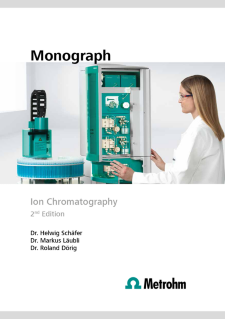
Monograph: Ion Chromatography

Download your free monograph here

The fully revised and updated second edition of the monograph «Ion Chromatography» provides an in-depth exploration of the theory and practical applications of ion chromatography. Additionally, detailed discussions on the theory, detection methods, and separation column types are included.

Author
Schöneck

Thomas Schöneck

Product Specialist IC
Metrohm International Headquarters, Herisau, Switzerland

Contact