Share via email

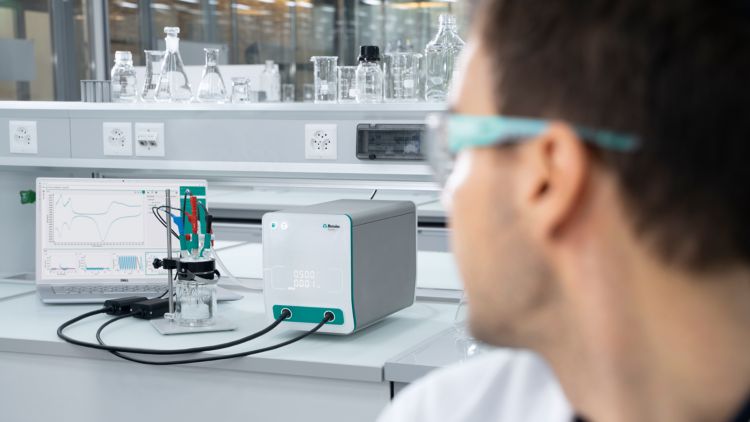
The shape of this CV is unique to ultramicroelectrodes – electrodes which are so small that the diffusion regime changes from linear to radial. This type of electrode is more sensitive and used often in sensing applications.

Understanding linear sweep voltammetry and cyclic voltammetry
May 12, 2025
Blog article
Linear sweep voltammetry (LSV) and cyclic voltammetry (CV) are among the most popular electrochemical techniques, and both are used for a variety of applications in labs all over the world. Their widespread adoption can be attributed to their simplicity, versatility, and the relative ease of the subsequent data analysis. This blog post explains the principles and parameters to be aware of for these two techniques, external factors that can influence the results, and concludes with some application highlights.
Linear sweep voltammetry vs cyclic voltammetry
Broadly speaking, electrochemical techniques can be divided into step and sweep techniques. Both LSV and CV are examples of sweep techniques and are typically performed in a three-electrode setup.
Read our Application Note to learn more about this setup.
The voltage at the working electrode (WE) is «swept» or «scanned» (changed in very small discrete values) from one potential (measured vs. the reference electrode) to another while the current flowing between the WE and CE (counter electrode) is measured.
Linear sweep voltammetry
The following example shows one of the most common uses of sweep techniques. When a redox probe is immersed in a solution, the voltage sweep starts in a region of potential where few reactions of interest take place. It continues through the kinetically controlled region and into the diffusion-limited region. This is what usually happens during the application of linear sweep voltammetry.
Figure 1a shows the E vs T signal of a typical LSV plot. Figure 1b shows the I vs E plot. This plot is typically analyzed following an LSV measurement.

Figure 1.
E vs T plot (a) and I vs E plot (b) from a typical LSV experiment. Marked on (a) is the start potential, stop potential, and the scan rate. Marked on (b) is Ep – the peak potential of the redox process under investigation.
The user can choose the voltage to start and end the sweep, as well as how fast to sweep between these voltages (i.e., the scan rate). The scan rate can significantly impact the resulting voltammogram. Varying the scan rate can reveal some important information, as shown later on in this article.
The effective range over which the voltage can be scanned depends on a number of factors, including hardware and software limitations and the experimental conditions. Different electrodes and electrolytes will create larger or smaller «electrochemical windows». These are the accessible potential ranges before the electrolyte itself begins to react.
Cyclic voltammetry
In the case of CV, the main difference is that the voltage that the WE is brought to during the first half of the experiment is not the final voltage (stop potential), as it is in LSV. It is the potential at which the direction of the sweep is reversed. This is usually called the switching or first vertex potential.
From this point, the potential either simply returns to the starting voltage or to a second vertex farther away from the starting voltage. At this second vertex, the direction of the sweep changes again and the potential goes back to the start voltage. Like LSV, with CV, the user can select the start/stop, first and second vertex potentials, and the scan rate.
There are two ways to describe CV data. The recommended IUPAC definition notes a positive scan direction and positive current as oxidation (or the anodic branch/scan) and negative scan direction and negative current as reduction (or the cathodic branch/scan).

Figure 2.
E vs T plot (a) and the I vs E plot (b) from a typical CV experiment. Marked on (a) is the start/stop potential (identical in this case), the first and second vertex potentials. Marked on (b) is Ep,a and Ep,c, the peak potentials of the anodic and cathodic peaks respectively.
Sweeping the voltage in this way allows users the possibility to probe both forward (oxidation in our case) and backward (reduction) in a controlled manner, which quickly gives insight into the reaction mechanism.
Of the two methods, CV has emerged as more popular for most general applications and especially for studying new systems, as the backward scan contains a lot of interesting information.
Data analysis
A cyclic voltammogram (the I vs E plot) can be assessed qualitatively. CV is a sensitive technique; by applying essentially the same E vs T signal to different systems, vastly different results are obtained. Figure 3 shows some of these results. The number of peaks, their shape and size, the separation between coupled peaks, and the response on the backward scan all contain information that can be used to draw conclusions about the system being studied.

Figure 3.
Some of the possible voltammograms that can be produced during cyclic voltammetry.
Briefly from Figure 3:
The reversibility of a particular redox reaction in CV is an important concept. Reversibility essentially means if something is oxidized (or reduced), how difficult is it to reduce (or oxidize) it and recover the original product? For example, when looking researching new materials for a rechargeable battery or capacitor, it’s important that the reaction is as close to 100% reversible as possible. Side reactions in batteries can cause them to malfunction and fail.
CV allows researchers to broadly classify different redox processes into one of three categories:
- irreversible
- reversible
- quasi-reversible
The scan rate plays an important role in helping to classify processes. The first two categories are more easily recognizable than the last.
In an irreversible process, features (peaks) that are present in the forward scan may be missing or strongly shifted (<0.5 V) in the reverse scan. The peak heights may also be very different. When the scan rate is higher, the peak potential shifts to higher potential values.
For a reversible process, the opposite is true. The forward and backward scans always have the same features, and the peak height ratio approaches 1. With higher scan rates, the peak potential doesn’t shift. The separation between the anodic and cathodic peaks is 57/n mV.
The condition for a quasi-reversible process is a bit harder to define because it falls between the two extremes. A quasi-reversible process usually has similar features in the forward and backward scans, but the separation and peak potentials depend on the scan rate. These reversibility criteria are tested by measuring the CV again, but with different scan rates. The faster the scan rate, the higher the peak current will be because there is less time for diffusion to take place.
The diffusion coefficient can also be calculated from this experiment using the relationship described in the Randles–Ševčík equation. The diffusion coefficient basically indicates how fast a species is diffusing to the electrode and has an effect on the measured current. For a reversible process, the measured peak current should increase linearly with the square of the scan route. Figure 4 shows a plot of the peak current vs the square of the scan rate.

Figure 4.
CV of a reversible one-electron process (left). When repeated at multiple scan rates, this leads to a rise in peak current and a linear plot of peak current vs square of the scan rate (right), together with the Randles–Ševčík equation.
It’s important to note that physical effects (like pH, temperature, or solvent effects) also play a role in determining if a process is reversible or not. Therefore, along with the scan rate, these parameters can also be adjusted in a deliberate way to improve the understanding of a specific process.

Conclusions
Cyclic voltammetry and linear sweep voltammetry are among the most powerful and versatile techniques in electrochemistry. They are employed daily for their impressive versatility and ease of use. For more information about CV and LSV, check out our resources below on these topics.
Your knowledge take-aways
Blog post: Cyclic voltammetry (CV) – the essential analytical technique for catalyst research
Application Note: Revealing battery secrets with EC-Raman solutions
How to characterize a catalyst? Cyclic voltammetry in action

This White Paper covers the following content: Measuring the surface area of the electrode, evaluation of the activity and stability of the catalyst, and a case study and handy glossary.
Contact